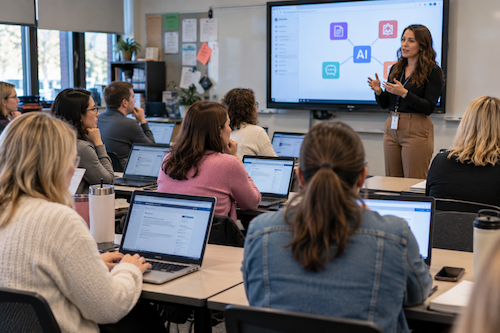
Districts across K–12 education are racing to help teachers understand artificial intelligence through workshops, guidance documents, and approved tool lists. This work has real value—teachers genuinely need clear instruction on privacy, accessibility, academic integrity, and appropriate AI use with students. But here's the uncomfortable truth: a teacher can walk out of an AI workshop with solid knowledge and still sit down to plan tomorrow's lesson with no idea how to actually use it.
A research-practice partnership conducted by Digital Promise with support from D2L offers crucial insight into why one-off training falls short. When faculty in higher education settings encountered an AI tool connected to a problem they were already trying to solve, they found it most useful. One participant had skipped professional development opportunities until an instructional designer showed how AI could help with weekly course overviews—what the educator called an "I-need-it" moment. This pattern reveals something fundamental about how educators learn: relevance emerges when a new capability meets a real need, not when it's presented in isolation.
In K–12 classrooms, teachers make instructional design decisions constantly and often alone. This reality makes access to trusted colleagues invaluable. Teachers need people who understand their specific context and can help them work through whether AI belongs in a particular lesson, assessment, or learning experience. A strategy appropriate for ninth-grade history may be entirely wrong for third grade. Using AI during lesson planning raises different questions than when students use it themselves. These distinctions cannot be sorted out in a workshop; they emerge through practice with guidance from people who genuinely understand the work.
Districts already employ instructional coaches, curriculum specialists, technology integrationists, library media specialists, and teacher leaders positioned to connect new ideas to classroom practice. Rather than creating new roles, districts should give these existing educators protected time to experiment with AI, involve them in tool evaluation and governance, and make their support available when teachers plan curriculum or examine student work. Smaller and rural districts might leverage regional service agencies. The job title matters far less than ensuring teachers have access to people who understand instruction, know local context, and have enough AI experience to help colleagues think critically about its use.
Districts also need to measure what actually matters. More AI use does not indicate better teacher preparation. Instead, districts should assess whether educators can evaluate AI critically, make choices that support learning, and explain their reasoning. They should create space for teachers to share experiences when AI tools failed—when they produced unreliable answers, created extra work, or reduced intellectual demand. These honest conversations build richer understanding of when AI belongs in practice and when other approaches serve students better.
Supporting teachers through AI's evolution requires more than workshops and champions with full workloads. It requires sustained, embedded support from people with time to experiment, authority to raise concerns, and no pressure to promote tools simply because districts approved them. Only then can teachers develop the judgment that transforms AI from a novelty into a genuinely useful addition to their practice.