# Tiny Robots Are Helping Scientists Map the Universe More Accurately
Ground-based telescopes struggle with a fundamental problem: they cannot observe the entire sky at once. Astronomers have long relied on wide-field imaging to capture large patches of the universe, but even the most advanced instruments miss data in specific regions. A new approach using thousands of coordinated micro-robots offers a solution to this persistent blind spot problem.
The innovation centers on positioning fiber optic cables with extraordinary precision. Telescopes like the Sloan Digital Sky Survey and the upcoming Dark Energy Spectroscopic Instrument (DESI) use fiber optics to collect light from distant galaxies and quasars. Each fiber must point exactly at its target. Positioning thousands of these fibers manually would take weeks. Instead, engineers now deploy arrays of small robotic actuators that position each fiber with micrometer accuracy in minutes.
This matters because incomplete sky coverage introduces systematic errors into cosmological models. When astronomers map galaxies and measure their distances, gaps in observation can skew calculations about the universe's expansion rate, the distribution of dark matter, and the prevalence of dark energy. Better maps require coverage of larger sky areas without sacrificing precision on individual objects.
The robotic positioning system works by placing individual motors at the end of each fiber. When a new observing target is selected, software sends commands that move thousands of these motors simultaneously. Each robot arm adjusts its fiber to align with a specific celestial object. The system can reposition the entire array for a new set of targets much faster than previous methods allowed.
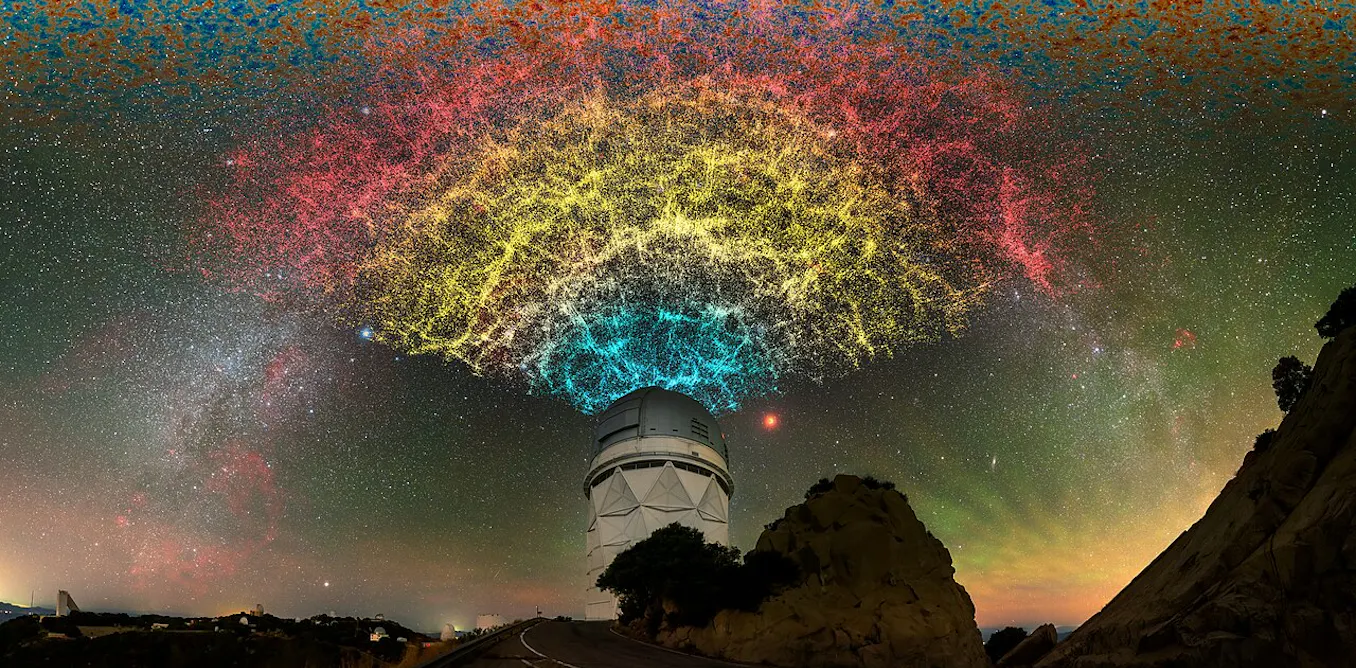
DESI, which began operations in 2021, represents the most advanced application of this technology. The instrument contains 5,000 robotic positioners working in concert across a focal plane measuring two meters in diameter. Over its five-year mission, DESI will create a 3D map of the universe by measuring the distances to 35 million galaxies and quasars. The robotic precision enables observations that would reveal the nature of dark energy by tracking how galaxy clustering changes across cosmic time.
Previous telescopic surveys faced real constraints. The Sloan Digital Sky Survey, which operated from 1998 to 2020, observed roughly one-third of the entire sky but required manual fiber placement for each observation, limiting observing efficiency. The shift to robotic positioning increased throughput dramatically.
Building better universe maps carries practical implications beyond pure science. Improved cosmological models inform our understanding of fundamental physics. They test whether dark energy truly represents a constant property of space or changes over time. They constrain theories about the universe's ultimate fate.
The technology also demonstrates how automation solves precision problems in science. Engineering teams had to solve mechanical challenges: eliminating vibration, ensuring repeatable accuracy over millions of repositioning cycles, and developing software that coordinates complex robotic motion instantly.
As surveys like DESI complete their observations, the data they collect will fuel astrophysical research for decades. Future ground-based surveys like the Vera C. Rubin Observatory's Legacy Survey of Space and Time will likely employ similar robotic systems. Each advance in positioning technology translates directly into denser maps of the cosmos, revealing the universe's structure with ever-greater clarity.