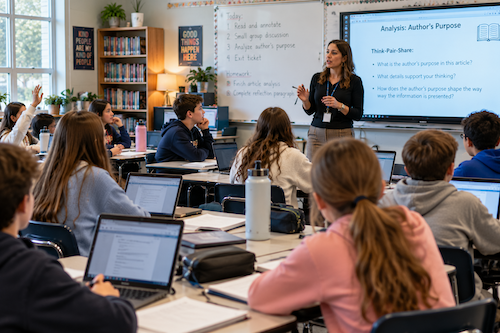
Working memory acts as the bottleneck in every classroom. When students absorb new information, their working memory capacity determines how much they can process at once. Exceed that limit, and learning stops. Teachers and school leaders who understand this principle can redesign instruction to protect student learning.
Working memory holds roughly five to nine pieces of information at any moment. This constraint shapes everything from lesson pacing to assignment design. A student trying to learn algebra while managing unclear directions, irrelevant visuals, and competing sounds experiences cognitive overload. The brain cannot consolidate learning when working memory becomes saturated.
Cognitive load theory, developed by John Sweller in the 1980s, explains why some teaching methods work and others fail. The theory identifies three types of cognitive load. Intrinsic load comes from the difficulty of the material itself. Extraneous load results from poor instructional design, confusing formatting, or unnecessary information. Germane load represents the mental effort needed to process and store new knowledge.
Effective teaching minimizes extraneous load while optimizing germane load. This distinction explains why some students struggle with particular lessons. A student might find algebraic concepts manageable in isolation but fail when the teacher adds multiple distractions simultaneously. Removing unrelated information, clarifying instructions, and presenting material in logical sequences all reduce extraneous load.
School leaders must evaluate tools and practices through this lens. Is a given technology reducing cognitive load or adding it? Does a new curriculum framework remove barriers to learning or create them? The questions matter because implementation decisions ripple across classrooms. A poorly designed assignment platform that confuses students about where to submit work adds extraneous load. An intuitive interface that mirrors classroom routines reduces it.
Working memory constraints also explain achievement gaps. Students from information-rich home environments often arrive at school with prior knowledge that reduces intrinsic load for new topics. They have vocabulary, experience, and background context already stored in long-term memory. Their working memory stays available for new learning. Students without that foundation must allocate working memory space to both the new content and contextual information, creating overload faster.
Classroom practices that protect working memory include chunking information into manageable pieces, reducing visual clutter on worksheets and slides, providing explicit step-by-step instructions, eliminating background noise, and allowing thinking time before expecting responses. Teachers who combine these strategies see measurable improvement in student retention and performance.
Technology adoption in schools must prioritize cognitive load reduction. Too often, schools implement tools that increase distraction rather than decrease it. A dashboard with excessive notifications, a learning platform with unintuitive navigation, or a video lesson crammed with animated transitions all harm learning. The most effective tools disappear into the background, supporting learning without drawing attention to themselves.
Understanding working memory and cognitive load transforms how schools approach professional development, curriculum design, and technology selection. Educators gain a scientific framework for evaluating their current practices. Leaders gain criteria for purchasing decisions. Students benefit because instruction becomes more aligned with how their brains actually work.
The bottleneck exists in every classroom. Schools that recognize this constraint and design deliberately to work within it accelerate student learning.