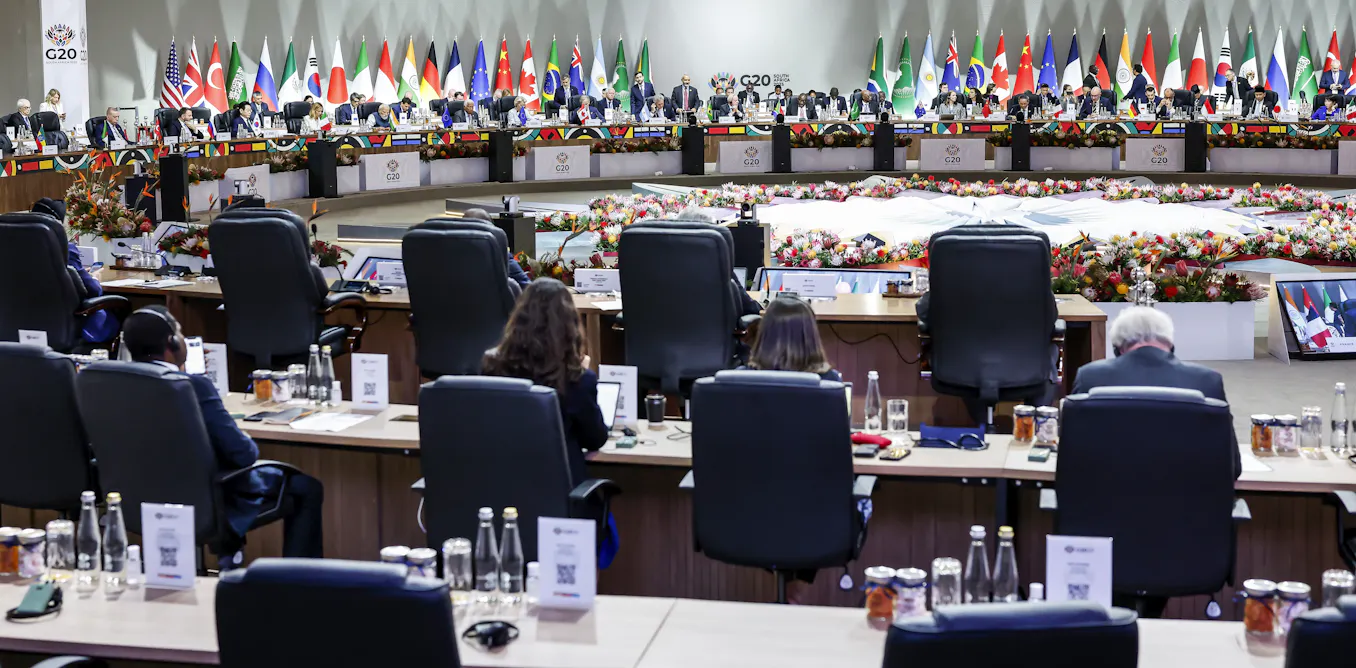
# G20 Needs Strategic Overhaul to Address Global Shifts, Says Expert
The United Kingdom holds the potential to fundamentally reshape how the Group of Twenty conducts its business, moving the bloc toward more agile problem-solving mechanisms suited to rapid geopolitical change.
The G20, which comprises the world's 20 largest economies, currently operates with structures designed for earlier global conditions. The organization brings together leaders from major developed and developing nations, including the United States, China, India, Japan, Germany, and others representing roughly 80 percent of global GDP. Yet the forum faces criticism for slow decision-making and difficulty adapting when international crises demand swift coordination.
The UK's upcoming presidency of the G20 creates an opening to redesign how member nations collaborate. Rather than relying on consensus-building processes that often result in watered-down statements, a revised approach could emphasize targeted working groups on specific challenges. These task forces could operate with clearer mandates and faster timelines, enabling nations to address emerging threats without waiting for full membership agreement on every point.
The current world order differs markedly from conditions when the G20 took its modern form following the 2008 financial crisis. Today's landscape includes AI governance questions, supply chain vulnerabilities exposed by pandemic disruptions, energy security concerns stemming from global conflicts, and climate-related economic risks that demand cross-border responses. Traditional G20 mechanisms struggle with subjects that did not exist a decade ago.
Several operational changes merit consideration. The UK could establish rolling agendas that allow new topics to surface between formal summits rather than waiting for annual meetings. It could create standing committees with delegated authority to make interim decisions, reducing bottlenecks. It could also strengthen connections between G20 finance ministers, development officials, and trade representatives so that decisions in one area do not conflict with advances in another.
The stakes extend beyond diplomatic protocol. When the G20 fails to function effectively, coordination gaps multiply. Nations pursue unilateral policies that create friction rather than alignment. Developing economies feel marginalized when major powers dominate discussions. Small island nations and least-developed countries lack meaningful seats at a table ostensibly designed for global problem-solving.
The UK presidency offers a concrete moment for institutional reflection. Previous presidencies, including those held by India and Indonesia, have highlighted similar structural challenges. Yet change requires political will from powerful member states accustomed to the current system. China and Russia have historically resisted rapid institutional reform. The United States and European nations have diverging priorities on economic and security matters that complicate consensus.
Reform also must balance representation with efficiency. The G20's broad membership base creates legitimacy but slows decision-making. Expanding participation or creating formal observer status for other nations could improve inclusivity while adding complexity. The UK leadership must navigate these tradeoffs thoughtfully.
Success will not come from dramatic restructuring alone. Incremental reforms like better preparation between summits, clearer division of labor among working groups, and transparent timelines for implementation could yield measurable improvements. These changes would signal that the G20 recognizes its own evolution is necessary for continued relevance.
The global environment will not wait for perfect institutional design. Crises emerge faster than bureaucratic consensus forms. The UK's opportunity lies in making the G20 less a talk shop and more an operational mechanism for genuine international problem-solving.