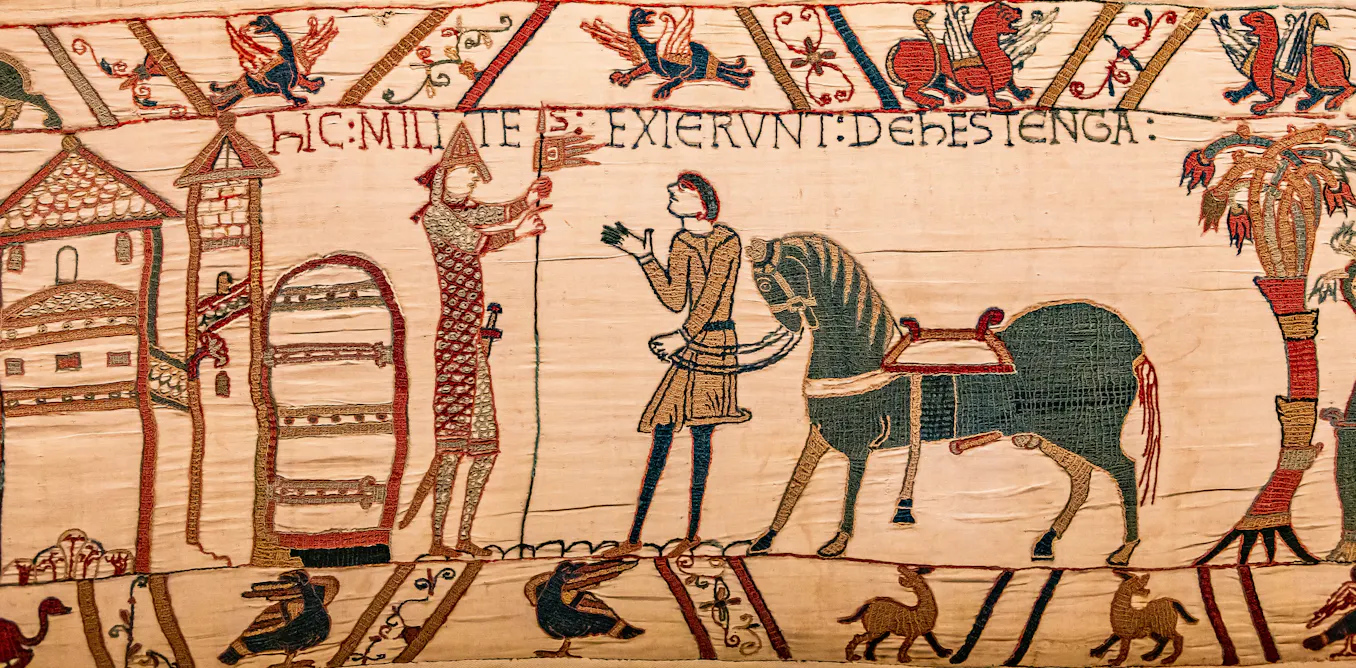
# The Bayeux Tapestry Reveals Medieval Storytelling Through Visual Narrative
The Bayeux Tapestry operates as a medieval embroidered comic strip, according to analysis from The Conversation. This 11th-century artifact demonstrates that visual sequential storytelling predates modern comics by nearly a millennium.
Created around 1070, the Bayeux Tapestry stretches 230 feet and depicts the Norman conquest of England in 1066. Rather than functioning as a static historical document, the work uses a series of scenes stitched in wool thread on linen cloth to guide viewers through a narrative arc. Each panel progresses logically to the next, much like panels in a contemporary graphic novel.
The technique employs what modern readers recognize as comic conventions. Figures appear in sequence across the textile. Action unfolds left to right. Repeated characters appear throughout to maintain narrative continuity. Latin captions label key moments, functioning similarly to dialogue boxes and titles in modern comics. The artist used visual shorthand to convey complex information, including symbols, body language, and composition choices that directed viewer attention.
Embroidered narratives served practical purposes in medieval society. Most people could not read Latin or French, but they could follow visual stories. The Bayeux Tapestry likely hung in churches or noble halls where it functioned as public entertainment and political propaganda simultaneously. The needlework format allowed the creator to produce a durable record that could travel and endure for centuries.
This approach to storytelling extends beyond the Bayeux example. Medieval craftspeople used embroidery, tapestry, and textile work to document hunts, battles, religious events, and personal histories. Women and men both participated in needlework production, though records often fail to credit individual contributors. The collaborative nature of creating large textiles meant multiple hands stitched scenes that conveyed unified narratives.
The comparison to comic strips reveals how visual sequential narrative represents a fundamental human impulse across time periods and cultures. Ancient Egyptian tomb paintings used sequential imagery. Japanese scroll paintings employed temporal progression. Indigenous American textiles incorporated narrative elements through visual patterns and arrangements. The form changes, but the principle remains consistent: people translate complex stories into visual sequences that audiences can follow without extensive written text.
Understanding the Bayeux Tapestry as a visual narrative tool reshapes how educators and students approach medieval history. Rather than viewing the tapestry as a documentary artifact, recognizing it as a constructed narrative crafted for specific audiences raises important questions about perspective and bias. Who commissioned this work? Whose version of the 1066 conquest does it present? What details did the creator emphasize or minimize? These questions parallel the analytical tools students already apply to modern media.
The textile arts continue to function as narrative vehicles in contemporary contexts. Artists use embroidery, quilting, and fabric work to document personal experiences, political resistance, community histories, and social movements. This lineage stretches directly from medieval needlework through to present-day practice, demonstrating that embroidered storytelling remains a valid artistic and communicative strategy.