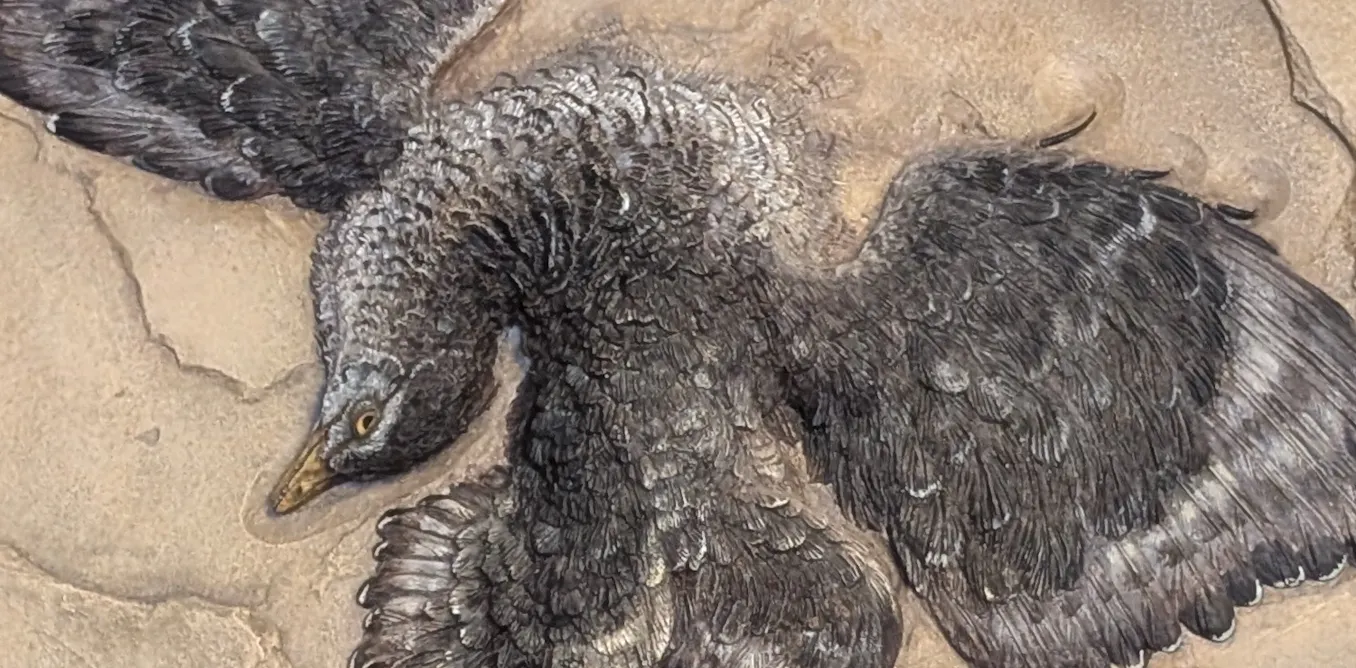
# How Archaeopteryx Became the Bridge Between Dinosaurs and Modern Birds
Archaeopteryx stands as one of paleontology's most pivotal discoveries, a creature that fundamentally reshaped how scientists understand the evolution of flight and the transition from dinosaurs to birds. This fossil organism, discovered in limestone deposits in Bavaria during the 1860s, reveals a remarkable hybrid body plan that clarifies a question that stumped researchers for generations: how did birds actually evolve from theropod dinosaurs?
The fossil record shows Archaeopteryx possessed features no other known creature of its time carried. Its skeleton retained classic dinosaur traits, including teeth, clawed fingers, and a bony tail. Simultaneously, it displayed unambiguous bird characteristics, notably well-preserved feathers and wings capable of generating lift. This combination made Archaeopteryx a living bridge between two classes of vertebrates that scientists had previously viewed as fundamentally separate.
The mechanics of how Archaeopteryx achieved flight remain a subject of active research and debate. Early interpretations suggested the creature climbed trees and glided down before eventually achieving powered flight through successive evolutionary refinements. Recent biomechanical analyses propose alternative pathways. Some researchers argue that small theropods used their proto-wings for balance and maneuverability while running on the ground. Others contend that feathered wings served thermoregulation or display functions before becoming instruments of flight.
What makes Archaeopteryx particularly valuable for education is its demonstration of evolutionary intermediacy in real time. Unlike abstract discussions of gradual change, this fossil provides concrete evidence that major evolutionary transitions leave physical traces. Students and educators can examine how natural selection modified dinosaur anatomy across millions of years, producing the anatomical structures necessary for powered flight.
The discovery also illustrates how science refines understanding through new evidence. When Archaeopteryx specimens first surfaced, they seemed to settle the dinosaur-to-bird transition decisively. Subsequent discoveries of other feathered theropods in China and elsewhere complicated that narrative productively. Scientists now recognize Archaeopteryx as one point along a continuum of evolving forms rather than a singular evolutionary breakthrough.
Classroom applications extend beyond paleontology. Archaeopteryx exemplifies how fossil evidence constrains evolutionary theory. Teachers can use the specimen to demonstrate how scientists construct evolutionary pathways using anatomy, geology, and biomechanics rather than speculation. Students learn that evolution generates predictions testable against the fossil record.
The ongoing research into Archaeopteryx's flight capabilities, feather structure, and ecological role shows that major discoveries don't end scientific inquiry. They redirect it. Each new analysis of preserved wing geometry, growth patterns preserved in bone, or comparative skeletal anatomy generates fresh hypotheses about how this ancient animal lived and moved through its Jurassic environment.
For educators teaching evolution and natural history, Archaeopteryx remains invaluable. The organism embodies principles central to modern biology: descent with modification, the gradual accumulation of adaptive traits, and the deep continuity linking all vertebrate life. Its wings carried more than one creature through ancient skies. They also carried science toward a fuller understanding of life's history on Earth.