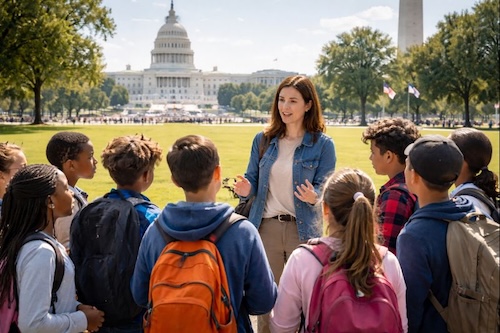
# Schools Push Civic Learning as Nation Approaches 250th Anniversary
America's 250th birthday in 2026 is prompting schools to reimagine how they teach citizenship and government. Rather than treating civics as a standalone subject confined to textbooks, educators are embedding civic engagement across the entire curriculum, asking students to see themselves as active participants in democracy.
The shift reflects a broader recognition that traditional civics instruction has failed to produce engaged voters and informed citizens. According to the Civics Learning Network and multiple education researchers, students who experience civics as something they "live" rather than simply study develop stronger commitments to community participation and democratic values.
Schools implementing this approach weave civic concepts into mathematics, science, literature, and social studies. A student in an English class might analyze political speeches alongside classic texts. Math students could calculate budget impacts of local policies. Science classes explore environmental regulations and their community effects. This integration makes abstract concepts concrete and directly tied to students' lives.
The rationale is straightforward. When every subject becomes a hub for civic engagement, students recognize that citizenship intersects with every domain of knowledge and decision-making. They begin to understand government not as a distant, incomprehensible system but as something they can influence through informed participation.
Several districts have launched pilot programs ahead of the 250th anniversary. These initiatives typically include classroom simulations of local government meetings, partnerships with community organizations, voter registration drives, and student-led research projects on neighborhood issues. Some schools invite elected officials and community leaders into classrooms for direct dialogue with students.
The timing of this push matters. Civic participation rates among young people have declined over the past two decades. The National Association of Secretary of States reported that voter registration among eligible voters aged 18 to 29 remained below 50 percent in recent election cycles. Meanwhile, surveys from the American Enterprise Institute found that many high school graduates lack basic knowledge about how government functions.
Educators argue that the 250th anniversary provides a natural teaching moment. Rather than viewing it as a celebration of the past, schools can frame it as an opportunity for students to consider what the next 250 years should look like and what role they will play in shaping the nation's future.
Some states have updated civics standards to reflect this shift. Arizona, Florida, and Ohio have recently expanded required civics coursework and added emphasis on participatory learning. These state-level changes create a framework for districts to experiment with integrated approaches without waiting for national curriculum reform.
Implementation challenges exist. Teachers need professional development to teach civics across disciplines. Curriculum materials must be updated to reflect contemporary issues and multiple perspectives. Partnerships with local government and community organizations require time to establish and maintain.
Despite these obstacles, the momentum continues building. Education leaders view the 250th anniversary as a deadline that coincides with urgent needs. If schools can produce graduates who understand how government operates and see themselves as capable citizens, those students will carry civic habits into their adult lives and voting years.
The goal extends beyond producing better-informed voters. Educators hope students will develop what researchers call "civic efficacy," the belief that their individual actions matter in shaping their communities. That mindset, educators argue, converts passive civics knowledge into active democratic participation.