# When STEM Lessons Are Too Easy, Students Stop Thinking
Teachers often mistake activity for learning. When STEM lessons lack sufficient challenge, students disengage from deeper thinking and coast through assignments without developing critical skills.
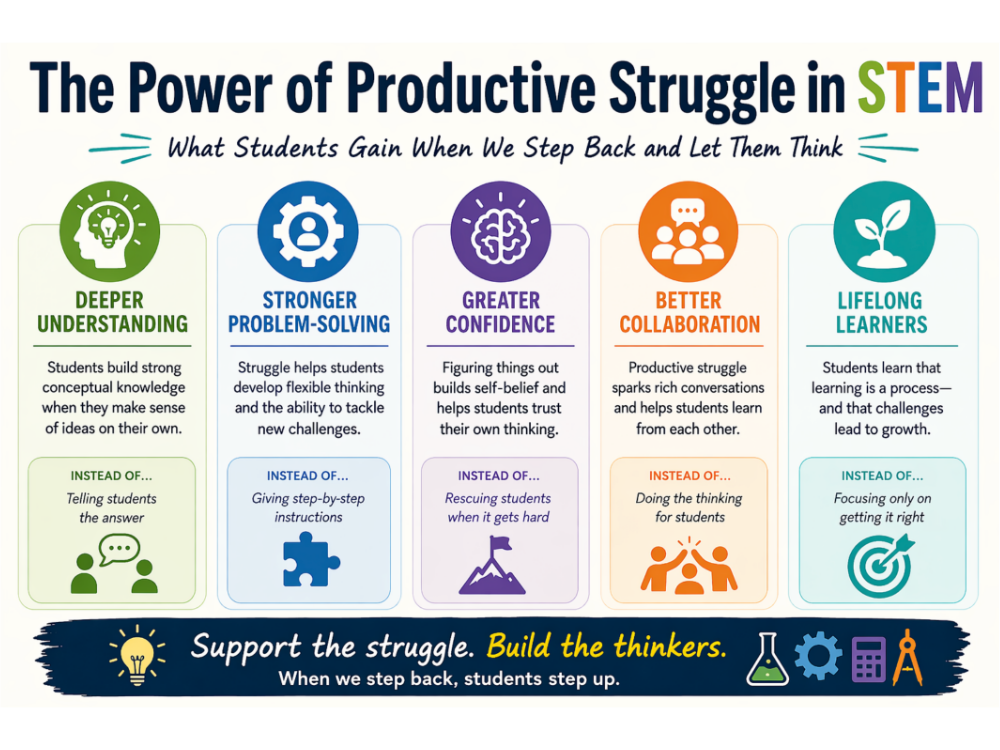
Research shows that students need productive struggle to build problem-solving abilities. If a lesson is too easy, learners skip the cognitive work required for real understanding. They complete tasks mechanically rather than wrestling with concepts that stretch their thinking.
The problem intensifies in STEM classrooms where procedural fluency matters less than conceptual grasp. A student can follow steps to solve an equation without understanding why those steps work. When material poses no resistance, students never discover what they don't know.
Engagement looks different at different cognitive levels. A student can appear engaged while doing busy work. They take notes, answer questions, stay on task. But genuine engagement involves grappling with ideas that don't immediately yield. It requires students to revise thinking, test hypotheses, and tolerate confusion before breakthrough.
STEM teachers face real constraints. Class sizes limit individualized pacing. Curriculum mandates push coverage over depth. Standardized testing encourages safe material that most students will answer correctly. Yet these pressures work against what cognitive science reveals about learning.
The solution requires rethinking lesson design. Teachers should frontload diagnostics to identify actual student understanding, not assumed understanding. Then calibrate difficulty so students work at the edge of their competence. Some will finish faster than others, which is fine. Those students need extensions that deepen thinking, not busywork that fills time.
Challenge also builds resilience. When students encounter problems that require multiple attempts, they develop persistence. They learn that confusion precedes clarity. They stop expecting immediate success and start valuing effort.
Balancing engagement with difficulty matters most in STEM, where surface-level learning masks incomplete understanding until students hit harder problems