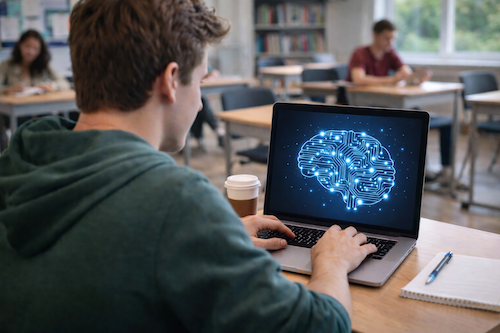
# Educators Must Accept AI in Schools and Redesign Assessments Accordingly
Schools cannot ban artificial intelligence from classrooms. The technology is already embedded in how students work, learn, and complete assignments. The real challenge for educators is not resistance but redesign.
Generative AI tools like ChatGPT, Claude, and similar platforms are now routine parts of student workflows. Students use them to brainstorm ideas, summarize research, translate texts, and draft essays. Attempting to eliminate these tools creates a false sense of security while ignoring how students actually work outside school walls.
The stakes of this reality matter enormously. Schools that pretend AI does not exist risk teaching students to view technology as something to hide rather than something to master. Students who learn to work effectively with AI develop a practical skill that employers increasingly expect. Those taught to avoid or fear the technology fall behind peers who understand its capabilities and limitations.
Educators and assessment designers now face a fundamental shift in thinking. Rather than creating "AI-resistant" assignments, schools must design assessments that assume AI is present and factor that reality into how learning is measured. This approach protects academic integrity while acknowledging how work actually gets done in professional and academic settings.
Practical redesign looks different depending on the subject and grade level. In writing classes, teachers might shift from evaluating final essays alone to assessing the entire drafting process, including how students use AI tools as research aids or editing partners. Students could be required to explain their choices, defend their arguments, and show their thinking. In mathematics, teachers can move beyond computational problems that AI solves instantly to assessments requiring explanation, proof, and conceptual reasoning. In science, students might design experiments and interpret results rather than simply collecting predetermined data.
The goal stated plainly: ensure that human thinking remains central. AI handles routine cognitive tasks. School assessments should measure what students think, how they reason, and what they create when routine work is automated.
Some schools have already moved this direction. They require students to document their use of AI tools, explain why they chose certain applications, and demonstrate their own contributions to final work. These approaches work because they align assessment with reality rather than fighting against it.Professional standards increasingly mirror this approach. Medical schools, law schools, and engineering programs now teach students to work alongside AI rather than compete with it.
The transition creates genuine challenges. Teachers need training in how to assess work in an AI-present environment. Rubrics require rethinking. Professional development budgets shift toward new skill areas. Schools without adequate resources struggle more than those with capacity to invest in teacher training and updated tools.
Yet the path forward is clear. Schools that accept AI as present and design accordingly prepare students for actual work environments. Those that ignore the technology or attempt total resistance leave students unprepared for the professional world they enter after graduation.