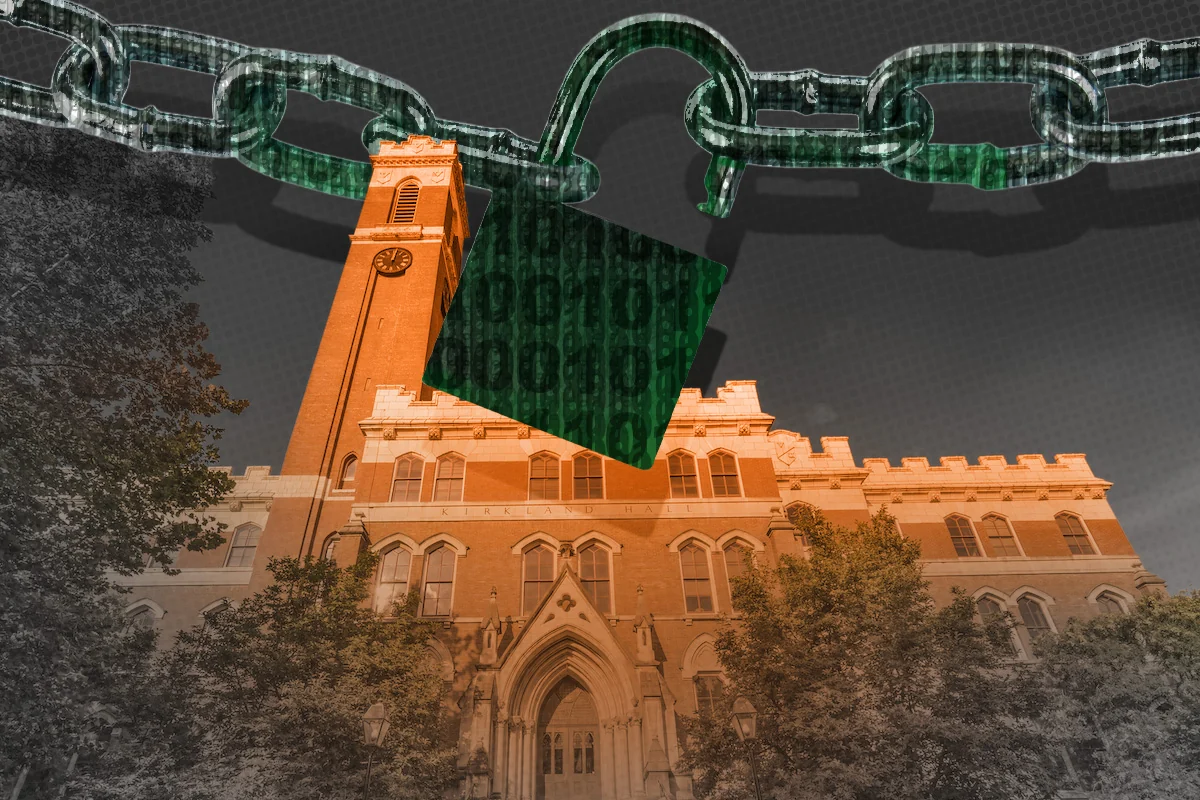
Vanderbilt University experienced a cybersecurity attack this week that forced the university to ask faculty, students and staff to shut down devices and disconnect from WiFi on Monday morning. The ransomware group BYOD claimed responsibility for the hack.
Classes continued as scheduled and WiFi was restored Monday night. By Tuesday morning, Vanderbilt had restored email, Zoom, Brightspace, Okta and enrollment services, though other systems remained restricted. The registration window for spring classes closes Friday, and the outage left some students unable to register during the disruption.
BYOD posted a message claiming it had obtained databases, research data, over one million Social Security numbers, full names, email addresses, phone numbers, and student and employee records from Vanderbilt's network. The group asked the university to contact them, stating "We will take you down when communication has been established between our team and yours."
Vanderbilt did not answer questions about what information was compromised, whether it paid ransom, or when systems would be fully restored.
BYOD launched in September and has claimed responsibility for breaches at 18 organizations, including Michigan State University and the University of New Mexico Health Sciences Center. The latter attack disrupted patient care at its hospital system.
According to Inside Higher Ed's 2026 Survey of Campus Chief Technology and Information Officers, 59 percent worry most about a critical cybersecurity breach or ransomware event. Sterling Wilson, a CTO at software company IGEL, noted that universities are "about the most open environments an attacker can find" because they have thousands of unmanaged personal devices, decentralized IT systems, and large stores of identity data on students, staff, applicants and research. He added that the academic calendar gives attackers leverage because campuses cannot stop teaching mid-semester.
Gary Barlet, public sector CTO at cybersecurity company Illumio, wrote that universities could avoid operational crises by designing systems to isolate compromised areas quickly while keeping the rest of the institution running, rather than taking critical systems offline entirely.