# Yellow-Legged Hornets' Appetite for Honey Bees Intensifies Eradication Efforts
Invasive yellow-legged hornets pose a direct and measurable threat to North American honey bee populations. New DNA analysis reveals that nearly one-third of the larvae food source for these hornets comes from honey bees, a finding that shifts eradication from a general pest-control concern to an urgent agricultural and ecological priority.
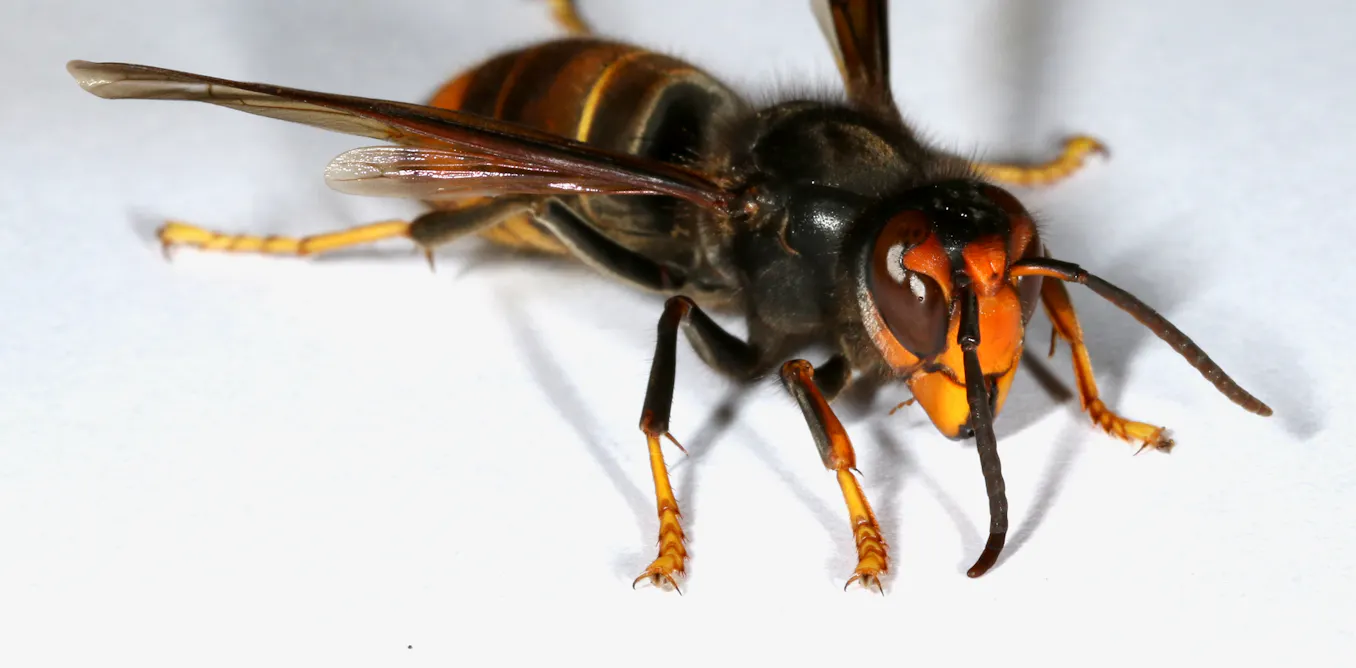
Yellow-legged hornets (Vespa velutina) arrived in North America in recent years after establishing themselves in Europe, where they have devastated bee populations across France, Spain, and other regions. Unlike native hornet species, these insects show a distinct preference for foraging among managed bee colonies and wild bee populations. The DNA testing breakthrough provides concrete evidence of this predatory behavior and quantifies the threat in ways previous observation could not.
The research identifies spring as the critical window for finding and eliminating surviving hornet nests before the population explodes. This "spring queening" phase, when new reproductive females emerge and begin establishing colonies, represents the species' most vulnerable period. A single fertilized queen can establish a nest capable of producing hundreds of workers by summer. Missing this window means facing exponentially larger populations within weeks.
Honey bee colonies represent not just economic assets but foundational food production infrastructure. Managed bees pollinate roughly one-third of food crops in North America, including almonds, apples, berries, and cucumbers. Wild bee populations, already stressed by habitat loss and pesticide exposure, cannot absorb losses to a predator as efficient as the yellow-legged hornet. The DNA evidence showing hornets derive 30 percent of larval nutrition from honey bees means each hornet nest directly competes with human food security and ecosystem health.
States where hornets have been confirmed, particularly Washington and Oregon, have launched intensive detection programs. Beekeepers receive training to spot nests and report locations. State agriculture departments deploy traps and deploy professionals to destroy confirmed colonies. The approach mirrors successful eradication efforts in other invasive species but requires speed and precision that "spring queening" timing makes essential.
The economic stakes extend beyond pollination. Beekeeping generates billions in direct revenue and supports rural economies. Beekeepers who lose colonies to hornet predation face immediate financial loss and reduced income from honey, pollination services, and other hive products. Commercial operations in affected regions report significant losses where hornet populations have become established.
Management agencies face a race against time. Each nest that survives winter produces multiple new queens by late spring. These queens disperse across hundreds of miles, establishing new colonies in summer. By fall, a single overlooked nest can seed dozens of new colonies across an entire region. The exponential growth trajectory means early detection remains vastly cheaper and more effective than managing established populations across landscape scales.
Researchers continue monitoring for additional hornet populations beyond confirmed locations. The combination of DNA analysis capabilities and coordinated early detection networks provides better tools than past invasive species responses. However, success depends on rapid action during the narrow spring window before populations rebuild.