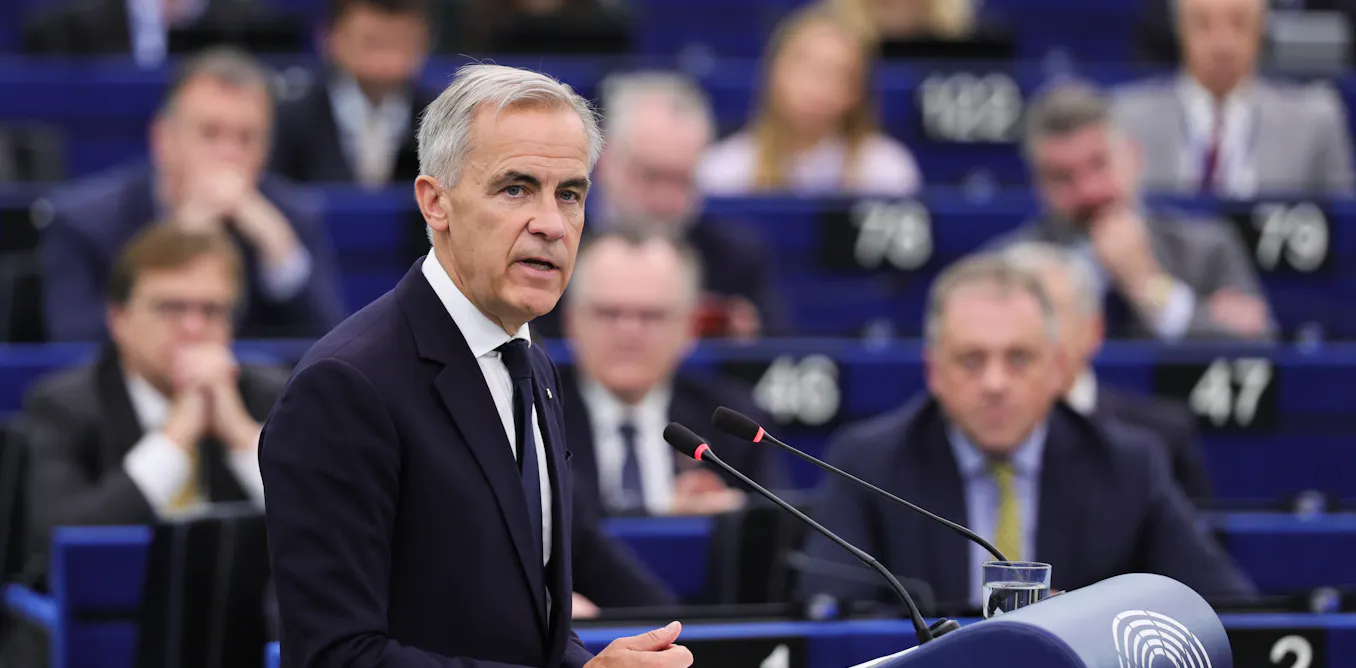
# Mark Carney Positions Himself as Ethical Voice in Leadership Vacuum
Mark Carney, the Canadian economist and former governor of the Bank of England and Bank of Canada, has emerged as a contrasting figure to American political leadership, according to commentary from The Conversation. The characterization positions Carney as operating from an "ethical high ground" amid what observers describe as a period lacking prominent, principled public voices.
Carney's career trajectory places him at the intersection of financial policy and governance. He led Canada's central bank during the 2008 financial crisis and later served as Bank of England governor from 2013 to 2020, where he shaped post-crisis banking regulation and monetary policy across the Atlantic. His positions required navigating complex economic pressures while maintaining public credibility. His current influence extends beyond traditional banking roles into environmental policy and sustainable finance conversations, a shift reflecting broader questions about central banks' responsibilities beyond inflation and employment targets.
The contrast drawn between Carney and American leadership reflects deeper concerns about rhetorical effectiveness and moral authority in public life. Where American political discourse often emphasizes volume and partisan positioning, Carney's approach emphasizes restraint, technical expertise, and what the commentary suggests is deliberate ethical positioning. This stylistic difference matters because it shapes how different publics perceive financial institutions and their leaders.
Carney's work on climate finance and sustainable economics has positioned him alongside other institutional voices attempting to address what many consider the defining policy challenge of the 2020s. His advocacy for central banks to acknowledge climate risk in their regulatory frameworks represents a departure from traditional central banking orthodoxy. These efforts put him at the forefront of debates about whether financial institutions bear responsibility for systemic environmental risks.
The "quiet Canadian" characterization carries particular weight in comparative context. Canadian political culture, broadly speaking, emphasizes consensus-building and measured communication over confrontational rhetoric. Carney's background in this context contrasts sharply with the polarized discourse dominating American public life. Whether this difference reflects genuine ethical positioning or effective branding remains a subject of interpretation.
His influence extends into global policy conversations. As chair of the Financial Stability Board, Carney shaped international banking standards affecting institutions across dozens of countries. His input into United Nations conversations about sustainable development and climate finance positioned him as a bridge between financial institutions and environmental advocates. This cross-sector work distinguishes him from predecessors whose authority remained confined to banking.
The commentary's framing raises questions about what "statecraft" means in contemporary contexts. Traditional statecraft involved diplomacy and national interest negotiation. Carney's version appears to emphasize technical expertise deployed toward ethical ends, a model some view as necessary leadership in an age of institutional complexity and global challenges.
His positioning as an alternative voice to American leadership patterns reflects broader international observation of a leadership vacuum. Many democracies report citizen concerns about whether their political and financial institutions maintain moral authority. Carney's consistent emphasis on ethical frameworks and long-term thinking offers a counternarrative to short-termism and rhetoric-driven policymaking.
The lasting question involves whether such positioning translates into institutional change or remains symbolic. Carney's technical competence appears genuine, but whether his influence produces measurable outcomes in climate finance, banking reform, or sustainable development requires empirical assessment beyond rhetorical effectiveness.