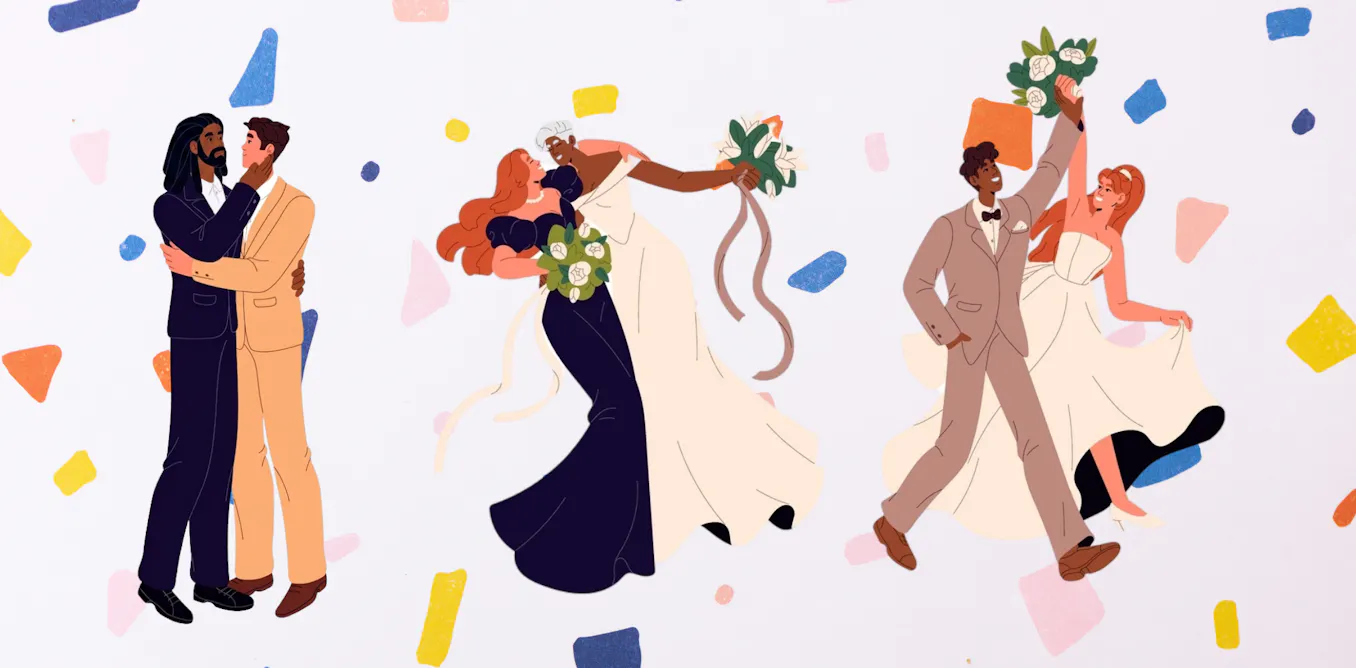
# Why Marriage Persists in Secular America, Even as Religion Wanes
Marriage rates have declined sharply in the United States over the past two decades, particularly among younger adults. Yet millions still marry each year. The reason often surprises those who assume religion drives the institution. Young people today marry for reasons that echo religious values while originating from secular culture.
The shift reflects a broader transformation in American society. Pew Research data shows that roughly 23% of Americans identify as unaffiliated with religion as of 2023, up from 16% a decade earlier. Among adults under 30, the number climbs higher. Despite this, marriage ceremonies persist, wedding industries flourish, and couples continue to formalize partnerships through legal and social rituals.
Religion historically provided marriage's primary framework. Churches taught that marriage created moral bonds, established family lines, and structured society. Today's secular marriages have absorbed these values without the theological language. A couple marrying in a city courthouse with no religious references still embraces concepts of commitment, mutual obligation, and permanence. These ideals were once inseparable from faith. They now stand alone.
Secular marriage culture emphasizes individual choice and emotional fulfillment in ways religious traditions did not. Young couples prioritize finding a partner with compatible values, shared life goals, and romantic connection. They delay marriage longer than previous generations, marrying on average at 30 for men and 28 for women, according to U.S. Census data. This represents an eight-year increase since 1980.
Yet the values embedded in marriage remain surprisingly traditional. Couples exchanging vows still commit to exclusivity, honesty, and shared financial responsibility. Wedding ceremonies, though stripped of religious content, retain ritual and symbolism. The white dress, the ceremonial vow, the public witness. These forms carry forward meanings that originated in religious practice, now detached from religious belief.
Economic factors shape marriage timing differently than in previous eras. Student debt, housing costs, and job uncertainty push marriage later in life. Some young adults forgo marriage entirely. Yet those who marry still seek what marriage has traditionally promised: a legal and social framework for long-term partnership, a recognized way to build family, and a commitment recognized by community.
Secular marriage also reflects changing gender roles that religious tradition resisted. Women now outnumber men in college enrollment. Two-income households are standard. Divorce laws grant women legal autonomy. These shifts would have been unthinkable in religiously structured marriage systems. Yet they coexist with marriage's persistence.
The data tells a mixed story. The share of Americans who have ever been married fell from 72% in 1980 to 58% in 2021, Census data shows. Marriage remains concentrated among college-educated, higher-income groups. Yet marriage has not disappeared. Instead, it has transformed. It has become a choice rather than an expectation, an achievement rather than a given.
This transformation reveals how institutions absorb cultural values across generations. Marriage survives not because religion mandates it, but because secular society has adopted marriage's core functions. It provides legal recognition, social legitimacy, and personal meaning. Young people marry when they do so for reasons that would satisfy their great-grandparents, even if they would not recognize the theology.