# Humpback Whales Shift Migration Feeding Habits, Prompting New Conservation Questions
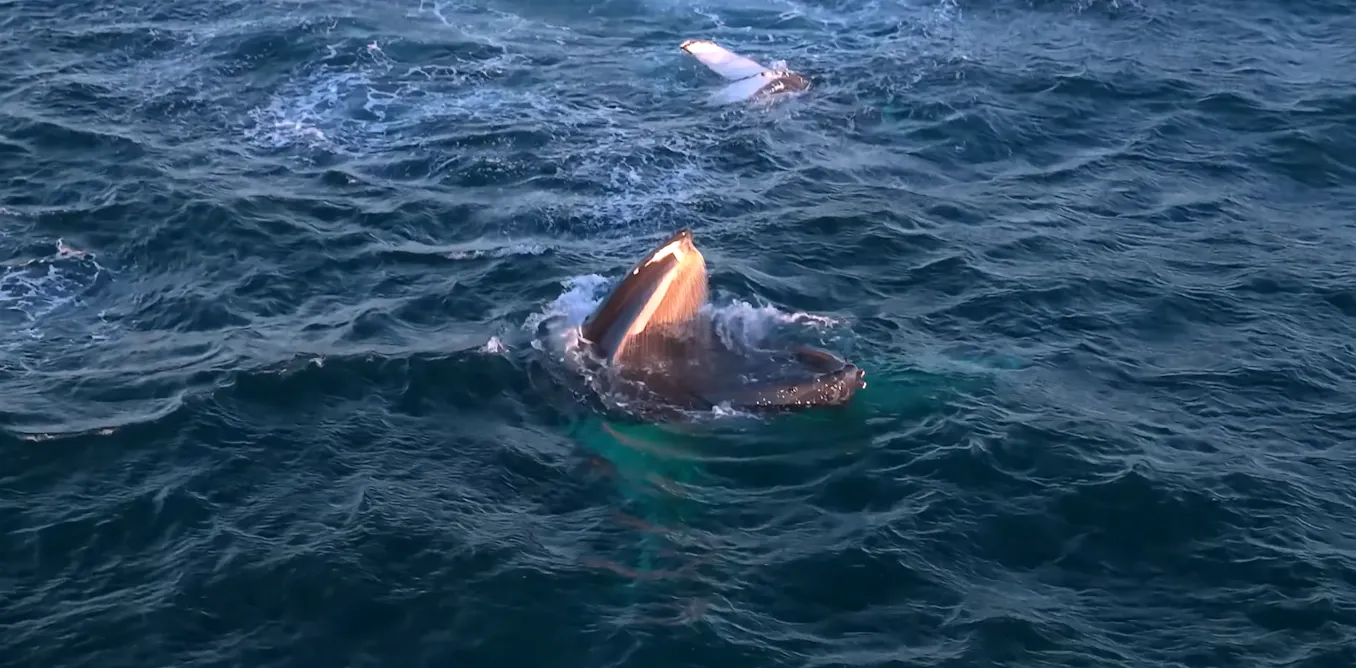
Researchers filming humpback whales migrating along Australia's coast have documented behavior that overturns decades of marine biology orthodoxy. The whales stop to feed during their long journeys between polar feeding grounds and tropical breeding areas, contradicting the widespread scientific belief that these migrations happen in a fasting state.
The discovery, captured on video by researchers tracking whale populations off Australia, reveals that humpbacks engage in opportunistic feeding during migration rather than surviving solely on energy reserves built up in Antarctic waters. This behavioral shift has direct implications for how scientists understand whale nutrition, migration patterns, and vulnerability to human activity.
"The discovery challenges a long-held assumption about where and when whales feed," according to marine researchers involved in the project. The finding matters because it changes where and how conservation efforts should focus. If whales feed during migration rather than only at polar destinations, they face different food availability pressures and encounter different shipping lanes and fishing zones than previously modeled.
Humpback whales undertake one of the longest migrations of any mammal on Earth, traveling roughly 12,500 miles annually between Antarctic krill-rich feeding grounds and warm breeding waters. The traditional model held that whales consumed enormous quantities of krill during polar summers, stored the energy, and then relied entirely on those reserves during their months-long migration and breeding period. This fasting assumption shaped decades of research, conservation policy, and population models.
Video documentation along Australia's coast shows whales actively pursuing and consuming prey while migrating. This behavior suggests that whales have adapted feeding strategies to take advantage of food sources encountered during their journey. The discovery opens new questions about prey availability in migration corridors and whether changes in ocean conditions affect whale nutrition outside polar regions.
The timing of this research carries weight. Ocean temperatures rise, currents shift, and prey distributions change due to climate pressures. If whales depend on feeding opportunities during migration, they face compounded vulnerability. Disruptions to food sources in migration corridors could impact populations far more than previously understood. Conversely, if whales can supplement energy reserves during the journey, they may have more resilience than models suggested, provided those food sources remain stable.
For marine conservation agencies, the findings suggest that protection strategies need expansion. Current marine protected areas and shipping regulations focus heavily on breeding and feeding grounds. Migration corridors, previously thought less critical because whales supposedly didn't feed there, now emerge as important habitats requiring management attention. Fishing practices, noise pollution, and vessel traffic in migration zones take on new significance.
The research also highlights the value of long-term video documentation in marine science. Many whale behaviors occur underwater or at distance, making direct observation difficult. Technological advances in drone footage and underwater cameras allow scientists to challenge assumptions built from limited historical data.
This discovery joins a growing body of research showing that animal behavior proves more flexible and complex than classical models assumed. As oceans change and whale populations respond, understanding their actual feeding ecology becomes foundational to effective protection. The next step involves scaling up observations and determining whether this feeding behavior occurs consistently across whale populations and regions, or represents local adaptation to Australia's specific prey landscapes.