# From Screen to World: Using AI to Spark Hands-On Learning in K-12
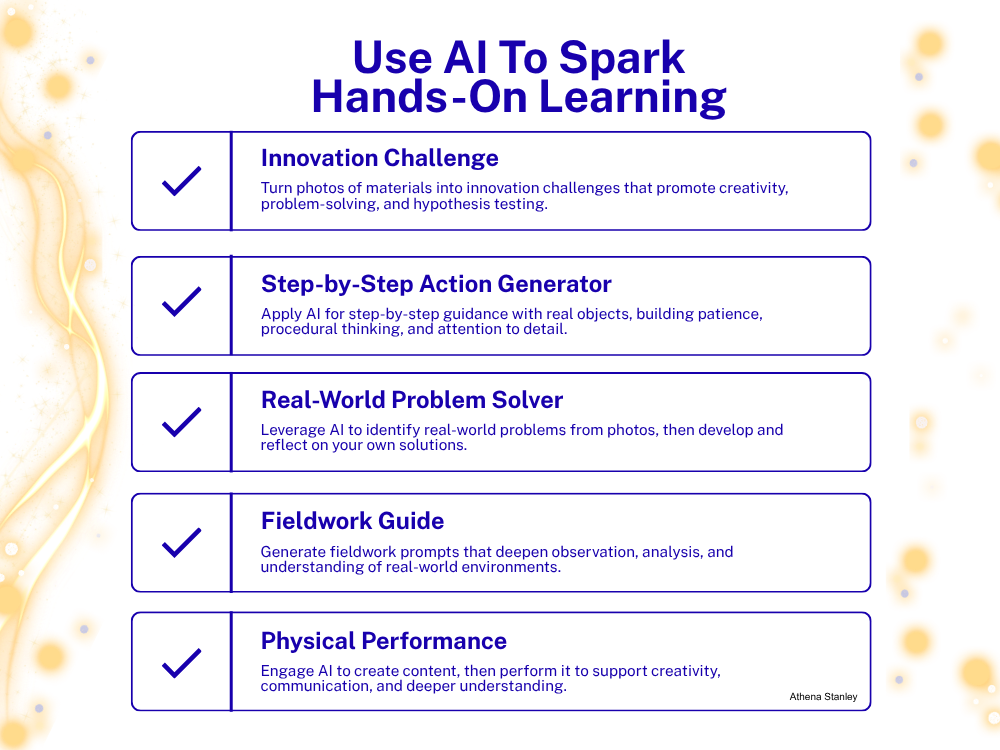
Teachers can use artificial intelligence to connect digital tools with real-world problem-solving in classrooms. One practical approach involves having students photograph their environment—at school, home, or in their community—then ask AI to identify problems within those settings without immediately offering solutions.
This method pushes students beyond passive screen time. Rather than scrolling through content, they become observers and questioners. The AI acts as a thinking partner, helping students recognize challenges they might otherwise overlook. A student photographing a cluttered hallway might ask an AI tool to identify safety hazards or inefficient traffic patterns. Another might photograph a local park and explore water quality issues or accessibility barriers.
The strategy works because it grounds abstract AI capabilities in tangible contexts. Students see AI not as a content engine but as a diagnostic tool. By withholding solutions, teachers force deeper engagement. Students must analyze the problems AI surfaces, research root causes, and design their own interventions. This aligns with inquiry-based learning principles that strengthen critical thinking.
Other applications TeachThought mentions include using AI to generate discussion prompts from photographs, helping students brainstorm solutions collaboratively, creating documentation of community needs, and developing student-led projects that address local issues.
The approach addresses a persistent challenge in K-12 education: bridging the gap between classroom learning and community impact. It also leverages tools students already understand. Most have used ChatGPT or image recognition software. Redirecting those tools toward observation and problem identification shifts their function from entertainment to learning.
Implementation requires minimal additional resources. Students need cameras (most have smartphones) and access to free or school-licensed AI platforms. Teachers benefit from training on how to frame questions that prevent AI from simply handing over answers.
This method transforms AI from a shortcut device into a cognitive scaffold.