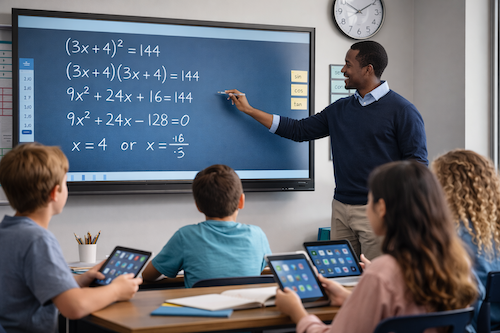
Schools cannot rely on artificial intelligence to solve fundamental problems with math education. Policymakers and educators must rebuild math standards from the ground up to prepare students for an AI-driven future.
The argument centers on a core truth: technology cannot fix broken teaching methods. As schools consider how AI tools like ChatGPT and tutoring systems fit into classrooms, many leaders assume these tools will automatically improve math outcomes. They won't. AI amplifies existing pedagogical weaknesses rather than correcting them.
Current math standards in most districts still emphasize procedural fluency and memorization. Students drill computational methods that calculators and AI systems now perform instantly. This approach leaves graduates unprepared for roles requiring mathematical reasoning, problem-solving, and conceptual understanding.
Rewriting standards requires educators to identify what humans need to do better than machines. Critical thinking, pattern recognition, real-world application, and mathematical communication matter more than speed or accuracy in calculation. Standards should emphasize deep understanding of why methods work, not just how to execute them.
Districts that have shifted toward conceptual learning report better student engagement and retention. These programs prioritize student-led exploration, collaborative problem-solving, and connections between mathematics and practical contexts. When teachers guide rather than lecture, students retain concepts longer.
The timeline for reform matters. High school students entering the workforce within five years face jobs that don't yet exist. If schools continue teaching 20th-century math content through 20th-century methods, those students arrive unprepared. Companies increasingly seek employees who can communicate mathematically, interpret data, and apply concepts to novel problems.
AI will play a role in classrooms, but only as a tool within stronger pedagogical frameworks. Tutoring systems can provide personalized practice. Computation tools can free time for deeper learning. Automated grading can give teachers insights into student misconceptions. These applications require standards that identify what matters most.