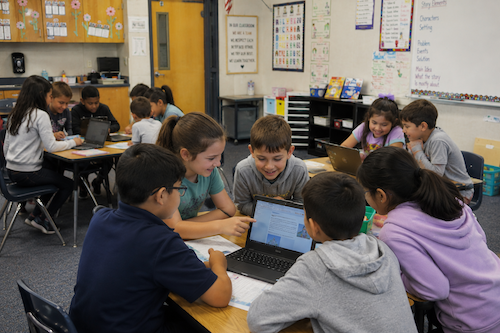
Project-based learning (PBL) is reshaping how students engage with mathematics by connecting abstract concepts to tangible design challenges. One school used backpack design as the entry point for teaching math skills, requiring students to apply geometry, measurement, and budgeting principles to a real-world problem.
In this approach, students don't simply solve equations on worksheets. Instead, they prototype functional backpacks, calculate dimensions and material costs, and refine designs based on user feedback. The work embeds fractions, area calculations, and spatial reasoning into an authentic context where errors have real consequences for their product.
PBL addresses a persistent challenge in math education: student difficulty connecting procedural skills to meaningful application. Traditional instruction often treats math as a series of discrete procedures disconnected from why those procedures matter. When students design something they'll use or give away, the math becomes necessary rather than arbitrary.
Research on PBL in math shows students develop stronger conceptual understanding when they work on extended projects. They retain skills longer and transfer learning more effectively to new situations because they've encountered mathematics through multiple representations.A strong foundation in elementary and middle school math matters because each concept builds on previous ones. Students who grasp underlying principles rather than memorizing procedures handle more complex mathematics with greater confidence in high school and beyond.
Teachers implementing PBL face real constraints: curriculum pacing demands, preparation time, and assessment challenges. Not every math skill fits naturally into project work, so PBL typically complements rather than replaces direct instruction. Schools scaling this approach need professional development for teachers and time to design projects aligned with standards.
The backpack design unit shows how PBL works when well-executed. Students encounter authentic constraints, make trade-off decisions, and see how mathematics solves practical problems. This shift from abstract to applied learning changes not just how students perform on math assessments, but fundamentally how they see mathematics as a