# Questioning as a Tool for Learning, Not a Sign of Weakness
TeachThought has released an updated guide that reframes classroom questioning as evidence of learning rather than academic weakness. The resource challenges a persistent misconception in education: that asking questions signals confusion or inadequate preparation.
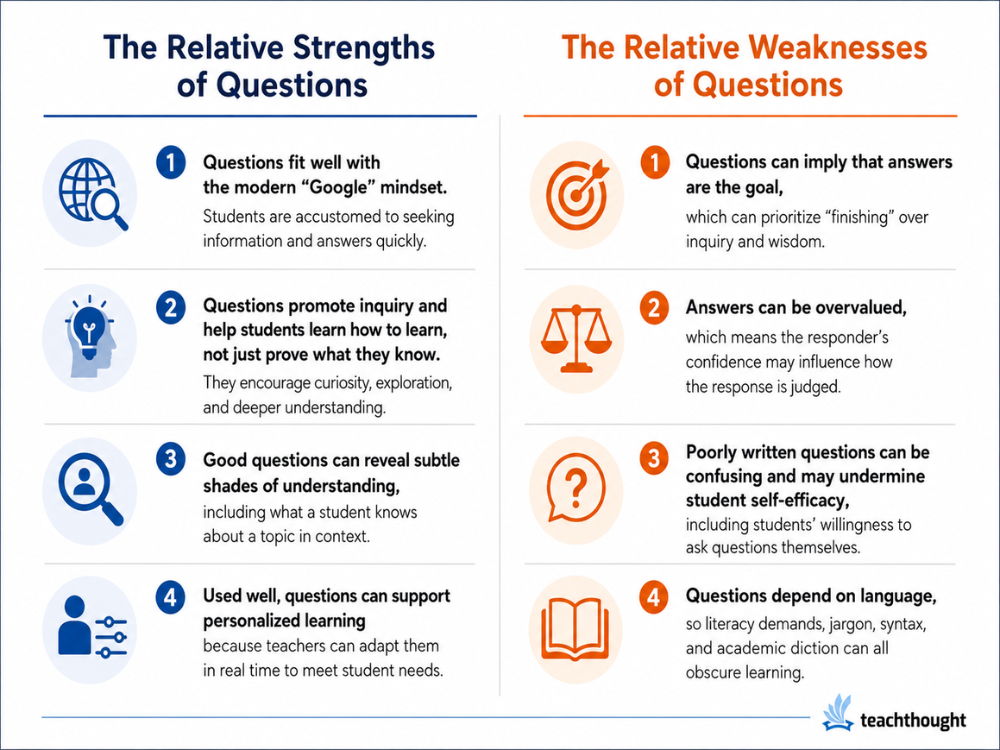
The guide positions questioning as an active cognitive skill. Students who ask questions demonstrate metacognitive awareness. They recognize gaps in their understanding and take steps to close them. This framing aligns with decades of learning science research showing that inquiry drives deeper comprehension.
The traditional model often discourages student questions. Classroom norms prioritize speed and correct answers over exploration. Students internalize the message that uncertainty equals failure. The updated guide inverts this logic. A student who asks "Why does photosynthesis require sunlight?" reveals more sophisticated thinking than one who passively accepts a textbook definition.
The resource addresses questioning for both students and teachers. For students, it emphasizes that questions serve as self-assessment tools. For teachers, it offers strategies to cultivate classroom environments where questions flow freely. This includes establishing psychological safety, modeling curiosity, and rewarding students who push back on explanations.
TeachThought's guidance reflects broader shifts in pedagogy. Modern standards emphasize critical thinking and problem-solving. Both require students to identify what they don't know. Standardized testing frameworks increasingly assess reasoning over rote recall. These changes make questioning skills essential rather than optional.
The guide includes practical classroom applications. Teachers can use student questions to assess learning, adjust pacing, and identify misconceptions in real time. When a student asks whether a concept applies in a different context, that question reveals transfer thinking and conceptual understanding.
Schools implementing question-rich classrooms report higher engagement and improved retention. Students take ownership of their learning when questions become normalized. The shift requires intentional culture building, but the payoff justifies the effort