# What U.S. and International Classrooms Can Teach About Math Instruction
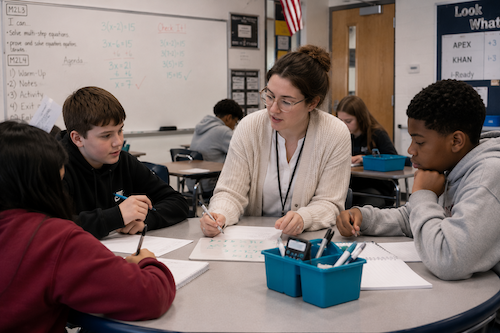
A math teacher's experience reveals a persistent problem in American classrooms: students master procedural skills without understanding the reasoning behind them. One advanced student could execute complex equations perfectly but struggled to explain why the method worked, exposing a gap between computational fluency and conceptual understanding.
This disconnect points to broader lessons embedded in how different education systems approach mathematics. International classrooms, particularly in countries like Singapore, Japan, and the Netherlands, prioritize conceptual development before procedural practice. Students learn the "why" before mastering the "how," building deeper mathematical reasoning that transfers across problem types.
U.S. instruction traditionally emphasizes procedural fluency first, teaching students to follow steps without necessarily requiring them to grasp underlying principles. While this approach produces students who can compute answers, research shows it creates brittle knowledge that fails when students encounter unfamiliar problem structures or must apply math in novel contexts.
The difference matters for equity and achievement. Students who understand mathematical concepts demonstrate greater persistence with difficult problems and show stronger long-term retention. They develop mathematical reasoning rather than mere memorization of algorithms.
Evidence from the Trends in International Mathematics and Science Study (TIMSS) and Programme for International Student Assessment (PISA) consistently show that countries emphasizing conceptual understanding achieve higher performance across diverse student populations. Teaching methods in these systems often feature fewer problems tackled more deeply, with class time devoted to discussion and explanation of mathematical thinking rather than rapid problem completion.
Adopting these approaches requires systemic changes. Teachers need preparation in content knowledge deep enough to explain reasoning clearly. Curriculum materials must shift from problem-heavy worksheets to fewer problems explored thoroughly. Assessment practices should evaluate student understanding, not just correct answers.
U.S. schools experimenting with these international approaches report improved outcomes. Schools implementing Singapore Math or similar programs show gains in