# What Is Cognitive Dissonance?
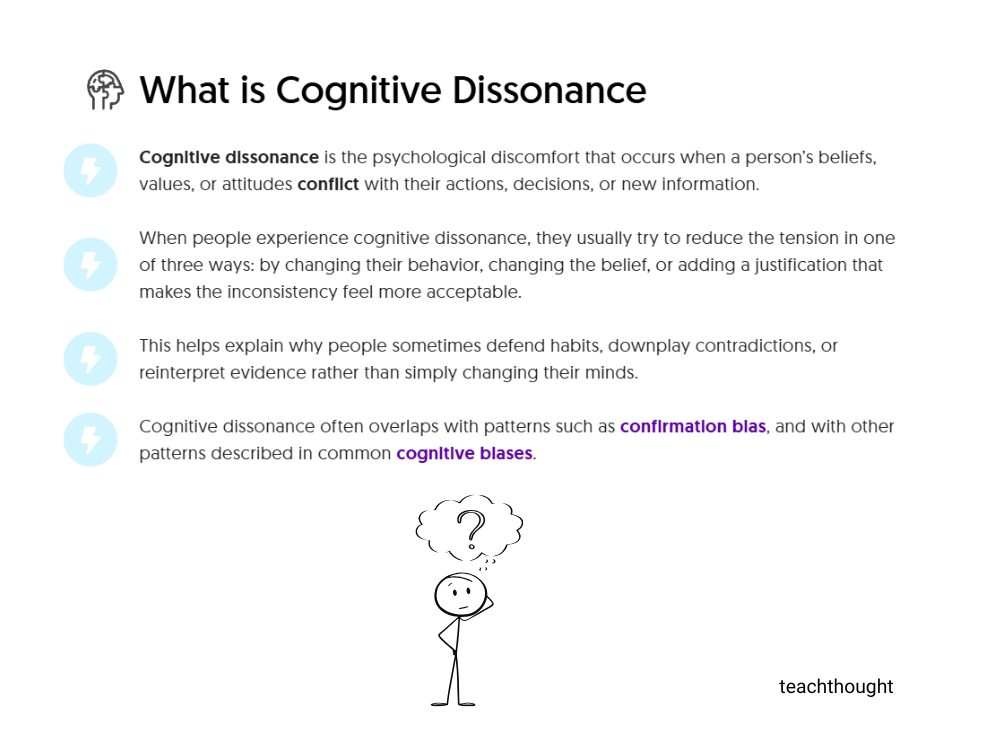
Cognitive dissonance describes the mental discomfort people experience when holding contradictory beliefs, values, or attitudes simultaneously. The concept applies directly to classrooms and learning environments.
Students encounter cognitive dissonance regularly. A teenager might value academic success while simultaneously avoiding homework. An adult learner might believe in the importance of environmental protection yet resist changing personal consumption habits. This internal conflict creates psychological tension that pushes people toward resolution.
Understanding cognitive dissonance helps educators design better instruction. Teachers can use it intentionally to prompt deeper thinking. When students confront contradictions between their assumptions and new evidence, they must actively reconcile the gap. This mental work strengthens learning and retention.
Cognitive dissonance operates differently depending on how strongly people hold their competing beliefs. Minor contradictions cause little discomfort and resolve easily. Strong contradictions between core values trigger greater tension and require more effort to resolve. People typically resolve dissonance through three pathways: changing beliefs to align with behavior, changing behavior to match beliefs, or seeking new information that reduces the contradiction.
Educators can leverage this mechanism in curriculum design. Science classes that present evidence contradicting student misconceptions create productive dissonance. History lessons that complicate simple narratives force analytical thinking. Literature classes that explore moral ambiguity push students to examine their own values. When teachers acknowledge the discomfort students feel, they normalize the learning process and help students recognize dissonance as a sign of intellectual growth.
The psychological principle also matters for teacher professional development. When educators receive research showing their current practices are less effective than alternatives, they experience cognitive dissonance. Supporting teachers through this transition, rather than dismissing their concerns, leads to more sustainable change.
Recognizing cognitive dissonance transforms it from an obstacle into a teaching tool. Rather than students avoiding the uncomfortable work of changing their minds, teachers can frame