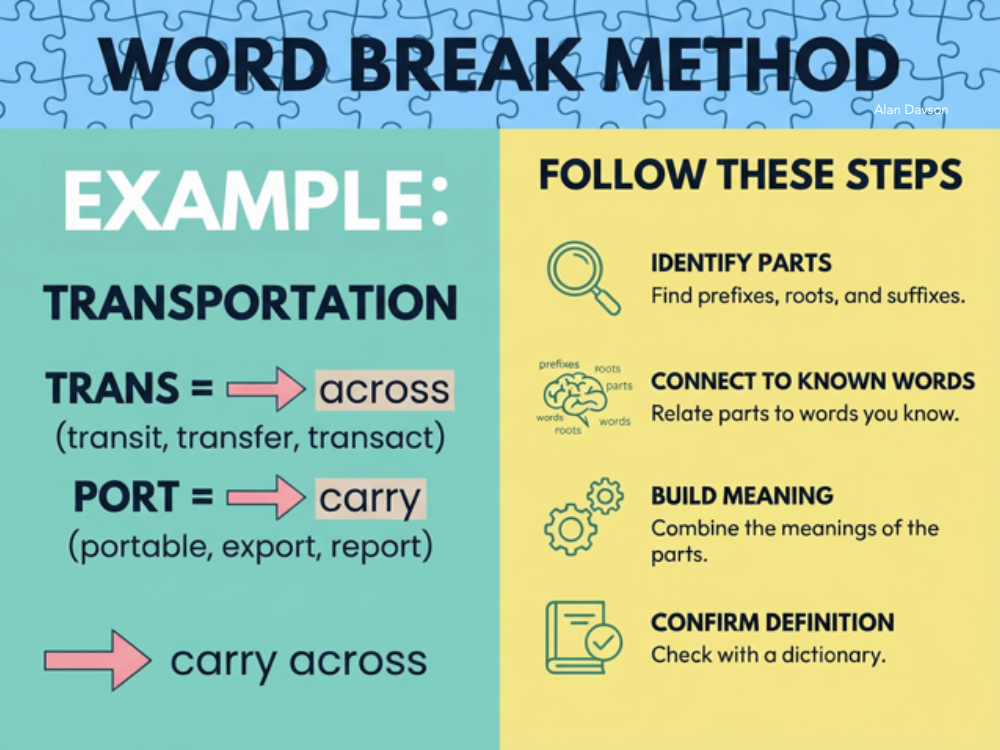
# How Breaking Words Changed the Way Students Approach Language
A classroom strategy of decomposing words into smaller units is shifting how students engage with vocabulary and reading comprehension. Teachers who implement word-breaking techniques report that students gain the ability to decode text while simultaneously building understanding of meaning.
The problem surfaces frequently in classrooms. Students can sound out words using phonetic skills but struggle when asked to define or explain what they have read. This gap between decoding and comprehension represents a critical disconnect in literacy instruction.
Breaking words into component parts, including prefixes, suffixes, and root words, gives students multiple entry points into meaning. When a student encounters "unhappiness," for example, deconstructing it into "un" plus "happy" plus "ness" creates a pathway to understanding. The student recognizes familiar units and builds meaning from their sum rather than treating the word as an isolated sound sequence.
This approach addresses a limitation in phonics-heavy instruction. While phonemic awareness and decoding form essential foundations, they do not automatically produce comprehension. Students need explicit instruction in how word structure connects to meaning. Morphological awareness, the understanding of how words are built from meaningful units, bridges that gap.
Teachers implementing this strategy report behavioral shifts in student confidence. Rather than shutting down when uncertain, students activate a mental toolkit. They ask themselves what familiar pieces appear in an unfamiliar word. This metacognitive process transforms students from passive readers into active problem-solvers.
The strategy works across grade levels and proficiency ranges. Struggling readers benefit from the explicit structure. Advanced readers benefit from deeper vocabulary knowledge and the ability to tackle complex academic texts. English learners gain both decoding and meaning-making support simultaneously.
Implementation requires no expensive materials. Teachers use existing curriculum texts and add explicit instruction in word families and morphological patterns. Even brief daily practice produces measurable gains in both reading fluency and