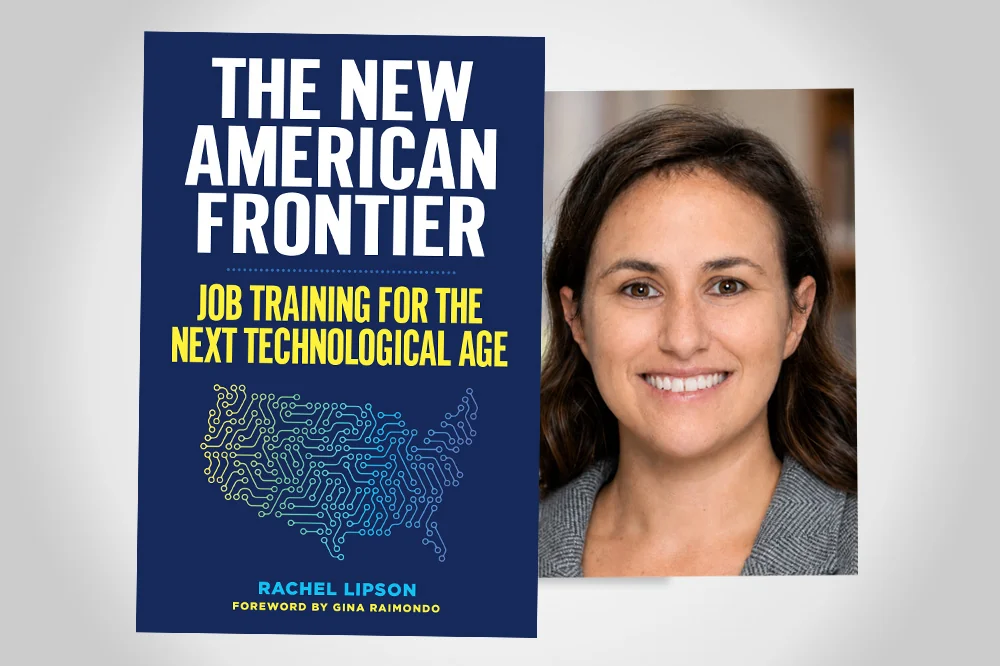
Rachel Lipson, a research fellow at the Harvard University Kennedy School, has published a new book titled "The New American Frontier: Job Training for the Next Technological Age" through Harvard Education Press. The book explores how community colleges can partner with businesses to train workers for emerging jobs in electric vehicle manufacturing, semiconductors, cloud computing and quantum technologies.
Lipson previously worked as a senior policy adviser in the CHIPS program office at the Department of Commerce, helping revitalize the U.S. semiconductor manufacturing industry. She wrote the book for college leaders and policymakers, explaining emerging industries, why they matter and what kinds of workers they need.
The book highlights instances in which community colleges have successfully expanded programs to meet evolving workforce needs in their regions. Lipson writes that next-generation technicians in data centers or semiconductor clean rooms will differ significantly from assembly line workers whose work was defined by repetition.
Community colleges are positioned to lead workforce development for emerging technologies because they exist in every part of the country, remain accessible and are more willing to train workers for specific jobs, Lipson argues. Many four-year institutions view job training as incompatible with their educational mission, she notes. Community colleges have historically worked directly with businesses through noncredit and continuing education programs that offer flexibility and tight connections with employers grounded in local economies.
Lipson points to examples in Colorado's quantum industry where companies founded by Ph.D. physicists now need technicians trained hands-on in laboratories. Community college programs begin with lab work and hands-on learning on day one, unlike bachelor's programs that emphasize theory first.
Colleges and employers face real friction in partnerships. Colleges are often paid by credentials while companies seek talent that delivers business results. They operate on different schedules and timelines. Public policy can help overcome these frictions by using resources to bring companies to the table, Lipson says. Texas's Skills Development Fund brought companies to work with colleges. At one Texas college, an engineering technologies department scaled from three instructors to past 80, mostly funded through company partnerships.
A misalignment exists in how success is measured. When students leave programs early because they land well-paying jobs, colleges count this as failure because the student did not complete their degree or certificate.