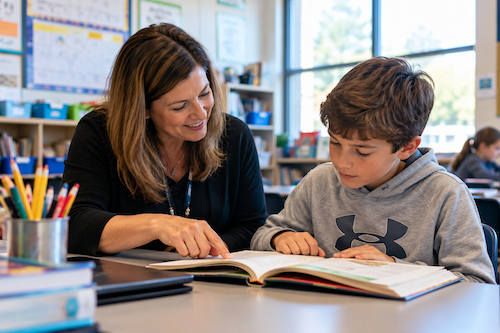
Making school accessible for students with dyslexia differs fundamentally from simply making it easier, according to an article by educators at The Southport School, which serves students in grades 2 through 8 with language-based learning differences and ADHD.
Students with dyslexia need explicit reading instruction, additional time, and alternative ways to access grade-level content. But simplifying assignments by shortening texts, reducing material, or lowering question complexity can create a second problem: the reading disability begins to limit access to ideas the student is fully capable of understanding.
Dyslexia is a specific reading disability. Absent other obstacles, students with dyslexia are capable learners, even when reading performance does not reflect their broader abilities.
Educators must first identify what specific barrier is causing difficulty. Two students may receive the same low comprehension score but need different instruction. One student may struggle with decoding longer words and need systematic instruction in advanced decoding skills and morphology. Another may read accurately but slowly and need support in text chunking and monitoring for understanding. A third may comprehend short passages but struggle to hold ideas across longer texts due to attention, stamina, or executive function challenges.
Instruction must then address that specific need directly with evidence-based, explicit reading instruction delivered with enough frequency and intensity to be effective. Materials and context should match the student's age. A middle schooler receiving foundational reading skills instruction should not feel as though they are back in grade school.
At The Southport School, students averaged 1.9 years of reading comprehension growth per year of enrollment in the most recent graduating cohort. At entry, 59 percent scored in the low-average range or below in reading comprehension. By graduation, 89 percent scored in the average range or above.
The article notes that high expectations must be paired with sufficient instruction and time for students to meet them. Students should also understand their own learning differences, recognize where they struggle and where they are strong, and learn to advocate for the support they need.