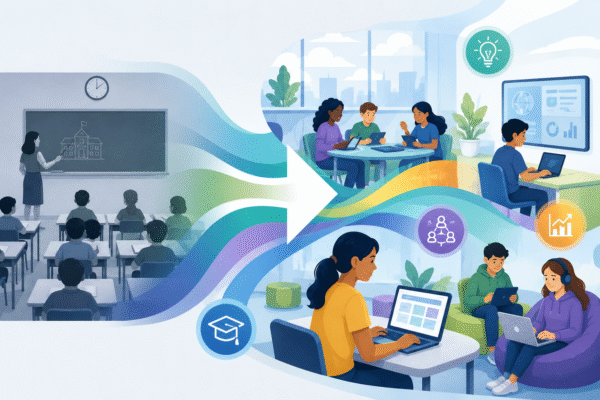
# Today's Classroom Design Doesn't Match Today's High-Achieving Students
American schools operate on a model designed a century ago. That model still works for many students, but it leaves high-performing learners frustrated and underengaged. The mismatch between how classrooms function and what today's most driven students need represents an overlooked equity problem that districts must address.
The traditional classroom groups students by age, moves them through material at a fixed pace, and measures success through standardized benchmarks. This structure served an industrial economy that needed workers with baseline skills. Today's top students often finish assignments before peers, wait for the class to catch up, and disengage from learning entirely. They sit in rooms designed to prevent their acceleration.
Enrichment programs and gifted tracks offer partial solutions, but they reach only a fraction of high-performing learners and often concentrate advantages among already-privileged families. Meanwhile, students who could thrive in accelerated environments instead adopt behaviors that match classroom expectations: they slow down, focus on grades rather than mastery, and sometimes hide their abilities to fit in socially.
This problem extends beyond gifted education. The rise of advanced learners reflects changes in family investment in education, access to tutoring, and early academic preparation. Schools see increasing numbers of students arriving in kindergarten with pre-literacy skills and mathematical reasoning beyond grade level. These students need different structures, not just additional worksheets.
The solution requires rethinking core assumptions about classroom organization. Districts must move beyond one-size-fits-all pacing and embrace structures where students progress through material based on demonstrated mastery rather than calendar dates. This means replacing rigid grade-level silos with flexible grouping that shifts based on subject and student progress. A fourth-grader reading at a sixth-grade level should access sixth-grade texts in reading, not just during designated "enrichment" time.
Teachers need support and time to implement differentiation at scale. Professional development must move beyond theory to include practical strategies for simultaneous small-group instruction. Technology can help here, automating progress tracking and adapting content difficulty, but devices cannot replace teacher judgment about when a student is ready to advance or needs targeted intervention in specific skills.
Acceleration itself requires policy shifts. Many states cap how many grade levels a student can skip and how early they can enter kindergarten or first grade. These guardrails aim to protect younger students from social misplacement, but they also prevent appropriately placed students from accessing grade-level content that matches their ability. Districts should evaluate acceleration on a case-by-case basis rather than applying blanket rules.
The classroom isn't broken for students following traditional academic trajectories. But for top performers, the structure actively works against learning. Addressing this requires districts to examine whether policies and practices serve all learners or only those who fit the average. That examination begins with a simple question: If a student already knows the material, what is the classroom actually teaching them?