# The Oral Exam Is Back. AI Is Forcing Educators to Reconsider Assessment.
Universities and schools are reviving oral examinations as a direct response to artificial intelligence tools that can generate convincing written work. The shift marks a fundamental rethinking of how institutions measure learning when traditional written assignments no longer reliably demonstrate student knowledge.
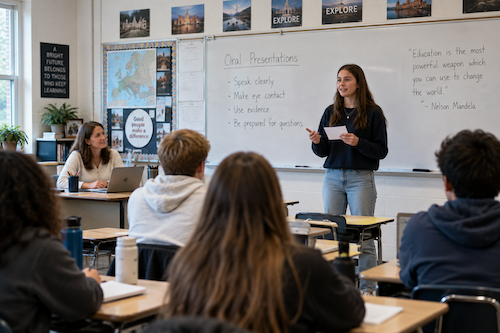
Catherine Hartmann, a professor at the University of Wyoming, assigned students in a history of meditation course a personal reflection project in 2023. Rather than collect a paper, Hartmann moved to oral presentations and discussions. This reflected a broader trend across higher education. Institutions recognize that written exams, essays, and take-home assignments face a credibility problem when students can submit AI-generated content.
The challenge runs deep. Large language models like ChatGPT produce text that passes surface-level scrutiny. Plagiarism detection tools struggle to identify AI-written work reliably. Professors cannot always distinguish between genuine student thinking and polished output from a machine. Written assignments, once the gold standard of academic assessment, now carry uncertainty about authenticity.
Oral exams address this problem directly. A student speaking to a professor or panel of examiners cannot hide behind a filter. Questions can follow student reasoning in real time. Examiners probe understanding, ask follow-up questions, and assess whether a student truly grasps material or merely regurgitates memorized phrases. The format forces live demonstration of knowledge.
Universities implementing this shift span multiple disciplines. Law schools have long relied on Socratic methods and oral arguments. Medical schools use oral defenses for theses and board examinations. Now humanities, sciences, and business programs are adopting similar approaches. Some institutions require oral components alongside written work. Others replace final papers with oral presentations entirely.
The return to oral assessment carries practical consequences. Scheduling becomes complex. Exams demand professor time. Large introductory classes cannot easily convert to one-on-one oral formats. But institutions view these costs as justified when assessment validity is at stake.
This creates new pressures on students. Oral exams reward communication skills alongside content knowledge. Students who excel in writing but struggle with public speaking face different demands. Anxiety about performance can spike. Some students report preferring written work where they can revise and polish. Oral formats demand spontaneous, accurate responses.
International universities have moved faster than American institutions. Cambridge University and Oxford University already emphasize vivas (oral defenses) for thesis work. European universities increasingly incorporate oral components into degree requirements. This trend accelerates as AI tools become more accessible globally.
The shift also reflects deeper questions about what learning truly means. Does a well-written paper prove understanding, or does conversation with an expert? Educators debate whether oral formats better assess critical thinking, analysis, and application of knowledge compared to written work. Some argue oral exams reveal gaps that written answers mask.
Schools also explore hybrid approaches. Video submissions where students record themselves explaining concepts, defend their reasoning, and answer follow-up questions filmed by examiners preserve some efficiency while adding authentication challenges. Proctored written exams with AI-detection software remain common, though confidence in these tools remains mixed.
The AI-driven return to oral examination reflects an uncomfortable truth. Traditional assessment methods relied partly on trust that a written submission genuinely represented a student's own work. That trust eroded. Institutions must now rebuild confidence in their ability to verify learning actually occurred.