# What Students Actually Remember from School Has Little to Do with Test Scores
Students forget most of what they memorize for tests. The facts, formulas, and dates vanish within weeks. But the lessons that stick follow a different pattern. Project-based learning, hands-on problem-solving, and real-world application create memories that last.
Research in cognitive science confirms this gap between retention and learning. When students passively absorb information through lectures or textbooks, their brains file it in short-term memory. That material exits the system after an exam. When students build something, solve an actual problem, or apply knowledge to their community, the neural pathways strengthen. The learning embeds itself.
This distinction matters because schools organize themselves around the wrong metric. Most American K-12 systems structure instruction to maximize test performance in the short term. Students cram. They perform. They forget. The system counts the performance as success, but the student leaves without lasting competency.
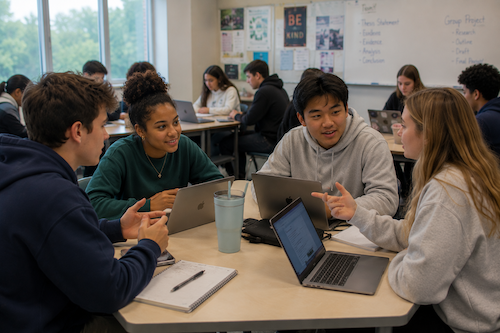
Project-based learning (PBL) reverses this dynamic. In PBL, students tackle real challenges. A group might design a water filtration system for a developing region, combining engineering, chemistry, and social impact. Another might investigate local environmental issues through data collection and analysis. A third might create a small business plan, testing marketing strategies and financial projections.
These projects demand that students retrieve knowledge repeatedly. They use facts not in isolation but in context. They practice skills the way professionals actually use them. The repetition and relevance both accelerate memory formation and deepen understanding. A student who designs a filtration system won't forget the principles of water treatment. A student who launches a mock business won't forget financial literacy.
PBL also builds what employers call soft skills. Curiosity deepens when students pursue questions that matter to them. Empathy grows through projects addressing community needs. Collaboration becomes essential when teammates depend on each other's contributions. These competencies transfer across domains. A student who learns to ask good questions in one project carries that habit into the next challenge and into adulthood.
The challenge for schools lies in implementation. PBL requires teachers trained in facilitation rather than content delivery. It demands time, resources, and space for messiness. Traditional schedules with rigid periods work against sustained projects. Standardized tests pull attention back to memorization. Districts investing in PBL report higher engagement and stronger retention of core concepts, but adoption remains uneven.
Some schools have built entire cultures around project-based work. High Tech High in San Diego, New Tech Network schools across the country, and growing numbers of public schools now center instruction on real-world projects. Student work appears in portfolios, not just test scores. Colleges and employers increasingly value this evidence of sustained learning and problem-solving ability.
The transactional model of school that students experience in many classrooms carries a hidden cost. It trains students to work for external rewards rather than genuine understanding. It prioritizes performance over learning. The alternative exists in schools willing to redesign instruction around what actually sticks. Students remember the problems they solved, the things they built, the people they helped, and the skills they practiced under pressure. That's what education for lasting learning requires.