# Zandra Rhodes' Archive at De Monfort University Becomes Teaching Tool for Fashion Design
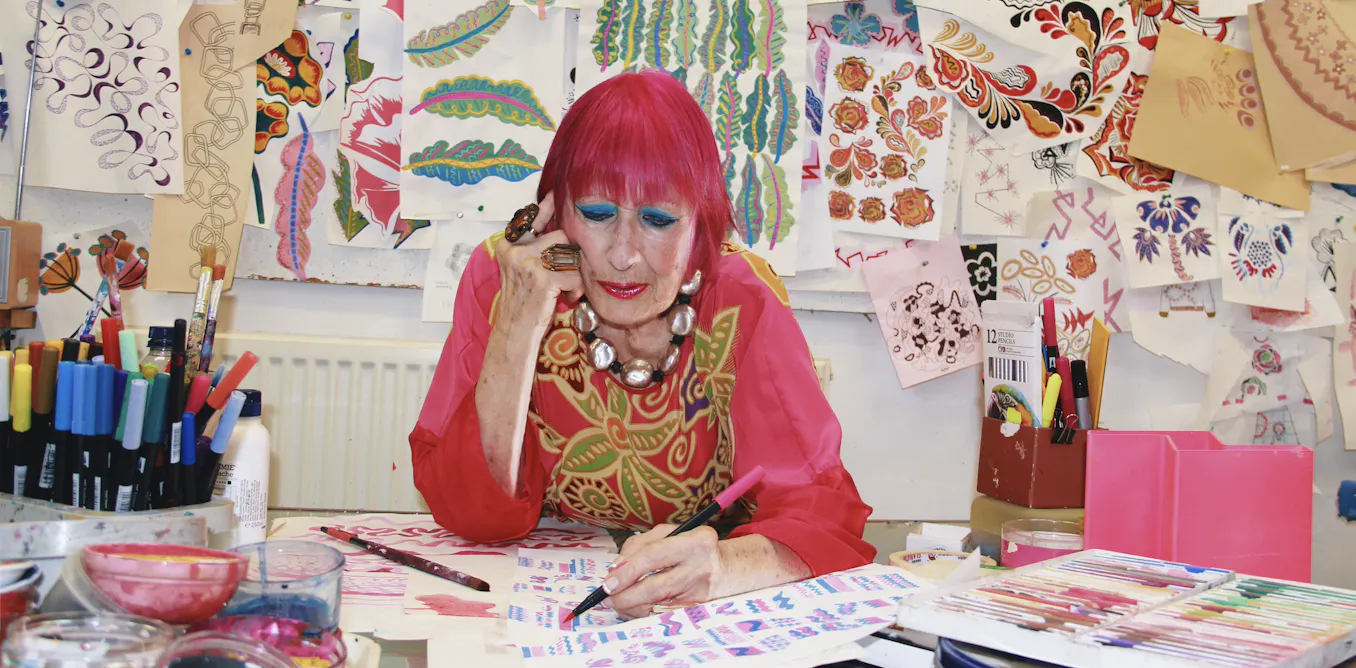
Zandra Rhodes, the pioneering British fashion designer whose avant-garde work once faced industry skepticism, has donated her complete archive to De Monfort University in Leicester, England. The collection now serves as a teaching resource for fashion students and emerging designers who draw directly from Rhodes' experimental approach to textile design and garment construction.
The archive contains decades of Rhodes' sketches, fabric samples, photographs, and finished pieces spanning her career from the 1960s onward. De Monfort University's fashion program integrates these materials into coursework, allowing students to study Rhodes' techniques in pattern-making, color theory, and unconventional fabric manipulation. Students access original design documents and learn how Rhodes developed her signature pleated and printed textiles that challenged conventional fashion aesthetics.
Rhodes built her reputation on bold prints and elaborate layering at a time when British fashion favored restraint. Her work appeared daring to mainstream audiences and retailers who initially resisted stocking her pieces. The label "too outlandish" followed her early career, yet Rhodes persisted in developing distinctive knitwear and dresses that combined fine art sensibilities with wearable fashion. Her influence eventually reached museum collections and high-fashion institutions.
The donation represents a shift in how fashion education values experimental design practice. Universities increasingly recognize that archives of working designers offer more practical instruction than textbooks alone. Students observe Rhodes' problem-solving process through her original sketches, revisions, and final pieces. They understand how she sourced materials, managed production challenges, and marketed unconventional work to skeptical buyers.
De Monfort University's fashion school has expanded its curriculum to emphasize sustainability and historical awareness. The Rhodes archive supports these goals by demonstrating how designers build lasting careers through innovation rather than trend-chasing. Students analyze which Rhodes designs endured commercially and which remained niche, extracting lessons about market viability versus artistic integrity.
The archive also serves researchers studying postwar British fashion, textile innovation, and women's contributions to design leadership. Fashion historians use the collection to trace how Rhodes' work influenced subsequent designers and manufacturers. De Monfort has digitized portions of the archive, making some materials accessible online for broader educational reach beyond enrolled students.
Fashion schools at Central Saint Martins, London College of Fashion, and other UK institutions have similarly benefited from designer donations in recent years. These collections help institutions demonstrate connections between historical practice and contemporary design challenges. Students see how past designers navigated technology shifts, manufacturing constraints, and changing consumer preferences.
The Rhodes archive reflects broader recognition that design education requires exposure to real working methods. Rather than teaching design principles in abstract, programs now emphasize learning from practitioners who solved actual commercial and creative problems. De Monfort's integration of the archive into course assignments ensures that Rhodes' decades of experience inform student projects directly.
For Rhodes herself, the donation validates a career once dismissed as too experimental. Her archive's presence in a university curriculum ensures that future designers will encounter her work not as historical curiosity but as active teaching material. The students using these materials will carry forward Rhodes' commitment to questioning fashion conventions and pushing technical boundaries.