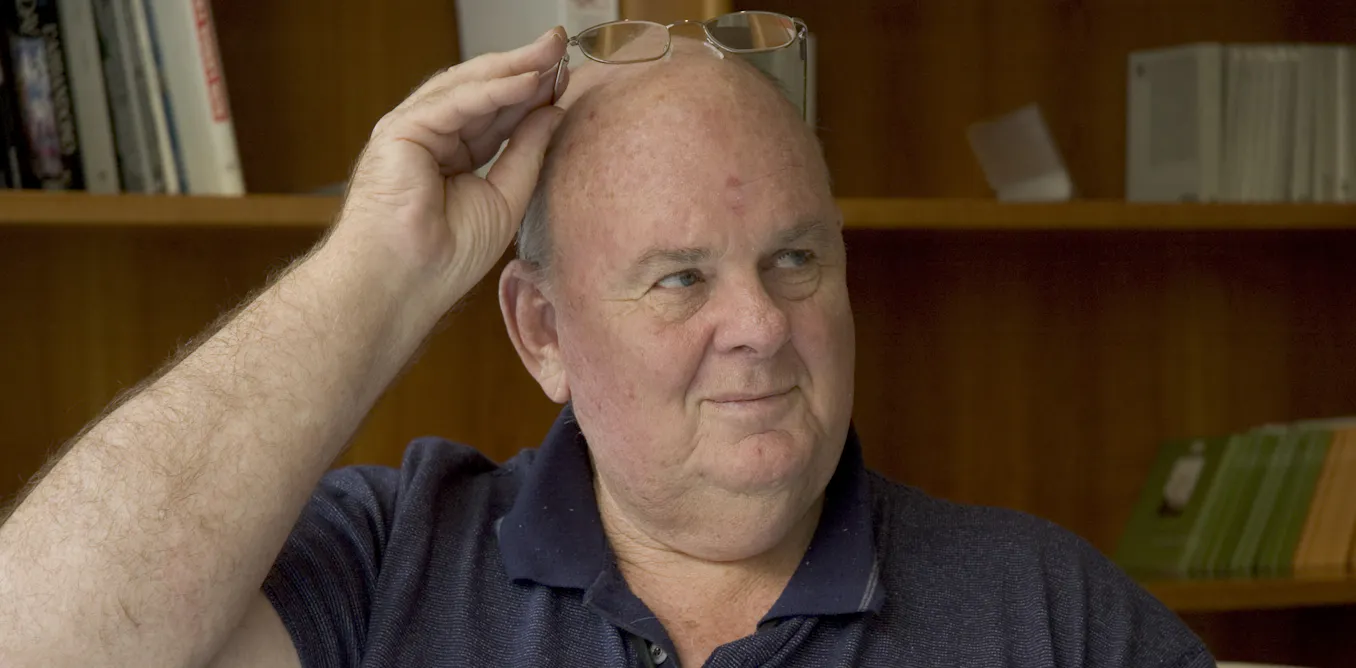
# Les Murray's 'The Broad Bean Sermon' Reveals Why He Remains Australia's Most Studied Poet
Les Murray's "The Broad Bean Sermon" occupies a peculiar place in Australian literary canon. The poem lacks the household recognition of his more famous work, yet it demonstrates the technical mastery and philosophical depth that elevated Murray to the status of Australia's preeminent poet in the eyes of many scholars and educators.
Murray, who died in 2020, spent decades crafting verse that moved between the vernacular and the elevated, the rural and the urban, the spiritual and the material. "The Broad Bean Sermon" exemplifies this range. The poem takes an ordinary agricultural subject—broad beans growing in a garden—and transforms it into a meditation on existence, language, and human purpose.
The poem's durability as a teaching text rests on its accessibility coupled with inexhaustible depth. Readers encounter it first as a simple narrative about beans. Multiple readings reveal layers of religious imagery, ecological awareness, and linguistic play. Murray embedded Catholicism, Australian rural tradition, and modernist technique within lines that appear straightforward on first encounter.
For secondary and tertiary educators, "The Broad Bean Sermon" solves a pedagogical problem. It allows entry-level students to engage with serious poetry without requiring specialized background knowledge. The poem rewards close reading without punishing initial confusion. Teachers can use it to demonstrate how poetry operates through compression, metaphor, and image rather than explicit statement.
The poem also speaks to contemporary interests in environmental literature and place-based learning. Murray wrote during decades when Australian literature increasingly centered Indigenous land perspectives and ecological crisis. His attention to the specific ground beneath his feet, the beans that grow there, and the labor required to cultivate them positioned his work as relevant to emerging curriculum concerns about sustainability and land stewardship.
Murray's broader reputation rests on his productivity and range. He published twelve major collections and numerous individual poems across a career spanning nearly sixty years. He resisted categorization as a merely "rural" or "Australian" poet, though his Bunyah property in New South Wales provided constant material. His work engaged with Catholic theology, European literary tradition, contemporary politics, and ordinary domestic life with equal conviction.
"The Broad Bean Sermon" matters in this context because it typifies Murray's refusal of false hierarchies. A sermon about beans is not less serious than a sermon about salvation. A poem about vegetable gardening can carry the weight of metaphysical inquiry. This democratic approach to subject matter influenced how Australian poetry developed in subsequent decades, encouraging younger poets to treat regional and domestic material as worthy of aesthetic ambition.
For students and teachers navigating Australian poetry curricula, Murray represents a bridge between mid-century modernism and contemporary practice. He wrote before the dominance of minimalism, and his maximalist approach to language and image offers an alternative model to sparse contemporary styles. His work remains taught intensively in Australian schools and universities precisely because poems like "The Broad Bean Sermon" reward sustained engagement while remaining rooted in observable reality.
The poem's status as a classic rests ultimately on its inexhaustibility. Each reading reveals new patterns, new meanings, new connections to other Murray poems and to the broader tradition of English verse. This quality of depth combined with accessibility ensures that "The Broad Bean Sermon" will continue to draw readers, students, and scholars back to the text repeatedly, extracting new nourishment from its deliberate cultivation.