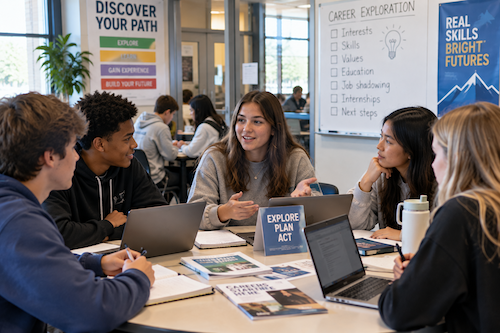
# Schools Must Connect Career Curiosity to Real Pathways Through Mentoring
High school students need more than exposure to different jobs. They need adults who can connect their interests to concrete career pathways and guide them through the steps required to get there.
This insight comes from veteran CTE instructors working in career and technical education programs. After eight years teaching Engineering and Architecture pathways, educators report a consistent pattern: students and families struggle to see how classroom learning leads to actual employment or further education.
The problem runs deep. Many high schools expose students to career options through job shadowing, guest speakers, or exploratory courses. But these activities often remain disconnected from structured pathways that show students exactly how to move from high school into careers or postsecondary training programs. Students leave unsure how to translate curiosity into action.
Mentoring fills this gap. When mentors who work in specific fields guide students through high school and beyond, outcomes shift. Mentors demonstrate what daily work actually looks like. They explain salary ranges, required certifications, and typical career progression. They answer the questions students don't know to ask. Most importantly, they make the connection between academic effort and tangible futures.
Career and technical education (CTE) programs position students to benefit from structured mentoring. CTE focuses on applied skills in fields like construction, healthcare, manufacturing, and technology. Unlike general academics, CTE integrates industry standards into coursework. When mentors connect this learning to job opportunities, students see relevance immediately.
Research on mentoring in CTE contexts shows measurable benefits. Students with mentors demonstrate higher graduation rates and greater likelihood of entering their field of study. They make more informed decisions about postsecondary education and career training. Families gain confidence in non-traditional pathways and see CTE as legitimate preparation for stable employment.
Implementation requires coordination. Schools must identify professionals willing to mentor. This demands effort from CTE departments and local employers. Many districts have launched CTE advisory boards where industry professionals shape curriculum and identify mentoring opportunities. Some programs assign mentors to cohorts of students, building relationships over years rather than one-time interactions.
The timing matters. Career exploration starting in middle school allows students to build skills and knowledge over time. High school mentoring then channels that curiosity into specific pathways. Students who enter 9th grade already interested in automotive repair or nursing benefit from mentors who reinforce that direction and explain next steps.
Not all students follow CTE pathways. But all students benefit from early career exploration combined with mentoring. General education high schools increasingly recognize this and partner with local employers to provide mentors across fields. College-bound students gain clarity on major selection and internship opportunities. Students entering trades connect with apprenticeship programs.
The evidence points in one direction: schools cannot simply inspire curiosity about careers and hope students figure out the next step. Curiosity without guidance often fades by graduation. Adding mentors who represent actual careers transforms exploration into direction. Students move from "I find this interesting" to "Here is how I get there."