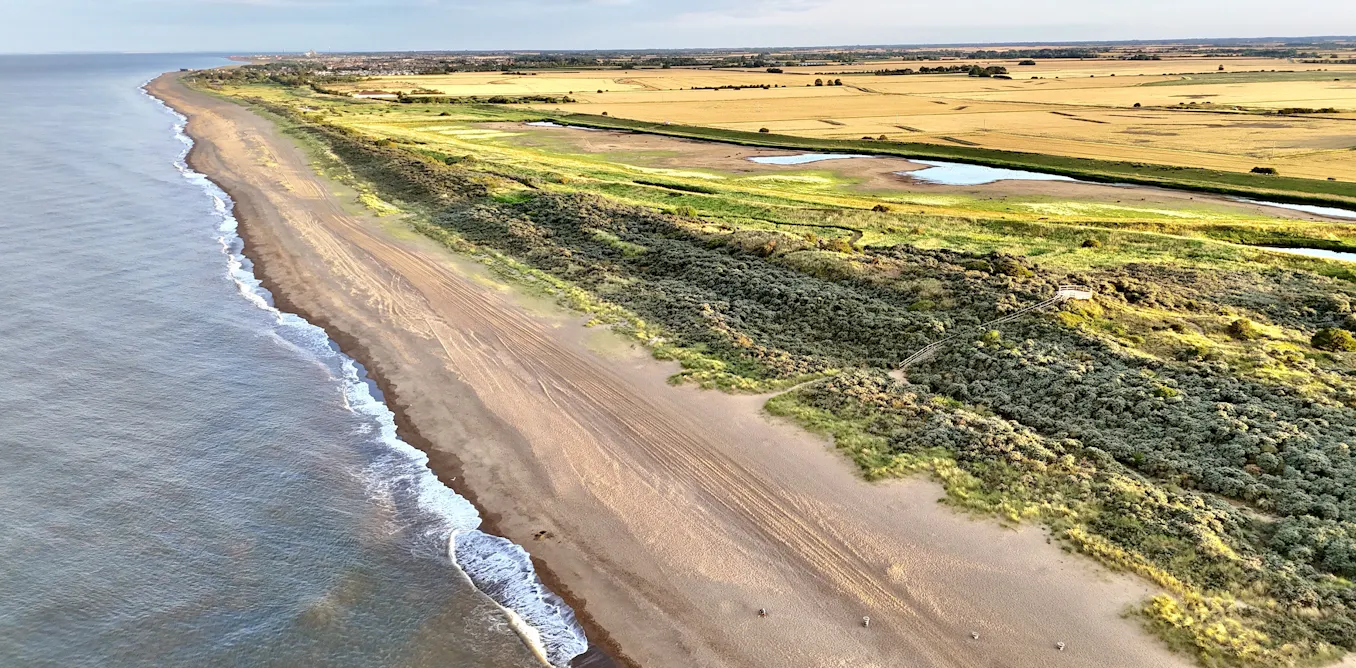
# Saltwater Flooding Threatens UK's Most Productive Farmland
Saltwater flooding poses an existential threat to some of Britain's most productive agricultural regions, particularly the Fenlands, where farmers grow roughly a quarter of the nation's vegetables and significant portions of its wheat, sugar beet, and potatoes.
The Fenlands span roughly 1,500 square miles across Norfolk, Suffolk, Cambridgeshire, and Lincolnshire. These low-lying areas sit at or below sea level, protected by centuries-old drainage systems and sea defenses. Rising sea levels and increased storm surge intensity from climate change now threaten that infrastructure. When saltwater breaches these defenses and contaminates soil, it renders farmland unusable for conventional crop production for years, sometimes decades.
Salt intrusion fundamentally alters soil chemistry. Most commercial crops cannot tolerate high salt concentrations. Wheat, barley, potatoes, and most vegetables fail when soil salinity exceeds even moderate thresholds. A single major flooding event can leave fields unproductive. Farmers in these regions face a stark choice: accept crop losses during recovery periods, invest heavily in drainage and remediation, or shift to salt-tolerant alternatives.
That shift is already underway. Researchers and agricultural innovators are exploring halophytic crops, plants that thrive in salty conditions. Seaweed cultivation offers one path. Samphire, a salt-loving vegetable, represents another option. Some farmers experiment with salt-tolerant varieties of conventional crops, though yields typically drop compared to standard varieties. Aquaculture operations could potentially replace traditional farming in affected areas, converting vulnerable farmland into fish and shellfish production zones.
The economic implications extend beyond individual farms. The Fenlands supply supermarkets, food processors, and export markets across Europe. Disruptions to production there ripple through UK food security and agricultural exports worth billions annually. Insurance costs spike for farmers in flood-prone zones. Property values decline. Rural communities dependent on agricultural employment face sustained economic pressure.
Government responses remain piecemeal. The Environment Agency maintains sea defenses and manages flood risk, but funding consistently falls short of maintenance needs, let alone climate adaptation investments. Some farmers access grants for improved drainage or land management, but these programs do not address the fundamental problem: saltwater contamination persists long after floodwaters recede.
Adaptive management strategies are emerging. Flexible cropping systems that rotate salt-tolerant and conventional crops show promise. Agroforestry and reed bed systems can filter salt-laden water. Floating farms and vertical agriculture in controlled environments represent extreme but viable alternatives for high-value crops.
The transition will not be voluntary or painless. Without major policy shifts and investment in adaptation infrastructure, the Fenlands face a slow economic decline as salt-vulnerable crops become unviable. Farmers must either innovate rapidly or abandon production. Food supply chains will adjust by importing more fresh produce or shifting sourcing to other UK regions and countries.
The timeline matters. Current projections suggest major saltwater incursions could affect significant portions of the Fenlands within 20 to 40 years if current sea level rise and storm patterns continue. That window allows for planned transitions, but only if farmers and policymakers act now.