# Today's Students Will Launch Ventures Powered by AI, Reshaping Entrepreneurship
Students entering the workforce over the next year face an unprecedented advantage. Artificial intelligence tools now sit at their fingertips, lowering traditional barriers to starting a business. Unlike previous generations, they won't need teams of developers, designers, or marketing specialists to launch. AI handles those roles. This shift promises to unlock entrepreneurship across demographics and economic backgrounds that historically faced obstacles.
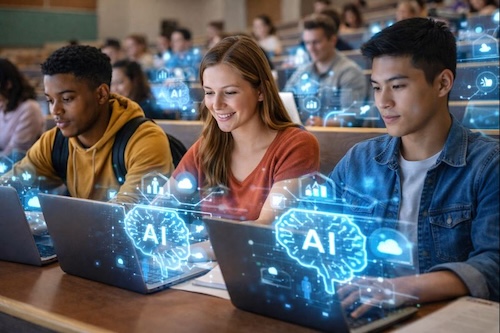
The timing matters. Current K-12 and college students have grown up alongside generative AI systems. They understand these tools intuitively. They see what GPT models, image generators, and coding assistants can do. Many already experiment with them in classrooms and personal projects. When they graduate, they won't waste years learning software or hiring specialists. They'll build directly.
What does this look like in practice. A student with an idea for a marketplace can generate UI mockups using AI image tools. They can write backend code without hiring a developer. They can draft marketing copy, design logos, and automate customer service chatbots. All from a laptop. The capital requirements drop drastically. Venture funding once required $100,000 to $500,000 for basic operations. Now an individual with domain knowledge and an AI toolkit can launch for near-zero cash.
History shows this matters. When desktop publishing emerged in the 1980s, it democratized print media. When WordPress launched in 2003, it made web publishing accessible. When Instagram arrived in 2010, it enabled visual creators without film equipment. Each wave created new entrepreneurs who previously lacked access. AI scales this pattern across nearly every sector. Healthcare startups no longer need medical illustrators. EdTech companies can build learning platforms without massive UX teams. Services businesses can automate operations that once required administrative staff.
Schools and universities must adapt to prepare students for this reality. Traditional business education focused on finding capital, assembling teams, and scaling operations. That curriculum assumes scarcity of technical resources. It doesn't. Forward-thinking programs now teach students to prompt engineer, evaluate AI outputs, and think about ethical implications of AI-powered products. They teach startup formation less as a barrier-requiring event and more as a toolkit anyone can use.
Challenges exist. AI-powered startups may face commoditization. When tools lower barriers to entry, differentiation becomes harder. A marketplace built with AI competes against dozens of similar AI-built platforms. Quality control matters more when founders skip some traditional steps. Students will need mentorship on product-market fit, unit economics, and customer acquisition. The tech becomes trivial. The business acumen doesn't.
Also, equity questions linger. Access to AI tools depends on internet connectivity and literacy. Rural and low-income students still face gaps. And AI training data raises questions about whose ideas get encoded into these systems. Schools must ensure all students, not just affluent ones in well-funded districts, gain fluency.
The prediction holds real weight. By 2026, we'll see college dropout founders with functioning AI-built startups. We'll see high school students launching side projects that generate revenue. We'll see more founders under 25 than ever before, simply because the friction of founding dropped. The question becomes whether education systems move fast enough to guide this wave.