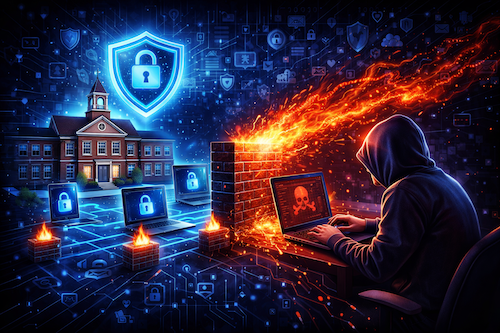
# Digital Resilience Has Become Essential Infrastructure for U.S. K-12 Schools
School districts across the United States face a stark reality in 2025. Cyberattacks on schools are no longer rare emergencies. They are predictable disruptions that district leaders must plan for as routine operational threats. Prevention matters, but it no longer suffices.
The shift reflects a hard truth: attackers will breach school networks. The question for district leaders is no longer whether an attack happens but how quickly schools recover when one does. This reframing drives the case for digital resilience as a core function of K-12 administration.
Cyberattacks on schools create cascading damage. When attackers penetrate district systems, they disable student information databases, halt grade recording, block access to learning management platforms, and encrypt files that teachers and administrators need daily. Some attacks also trigger ransomware demands. Schools have paid millions to restore systems or comply with extortion. Beyond the financial toll, attacks disrupt instruction. Students lose access to online coursework. Parents cannot check grades. Teachers cannot submit attendance. Trust erodes when families question whether their children's data remains secure.
The frequency of incidents validates the urgency. In recent years, attacks on school districts have accelerated. Ransomware groups specifically target education because schools often lack robust cybersecurity infrastructure and operate on tight budgets. The Cybersecurity and Infrastructure Security Agency, CISA, which sits within the Department of Homeland Security, has flagged K-12 as a sector where vulnerabilities persist.
Digital resilience differs from traditional cybersecurity. Prevention focuses on blocking attacks before they enter networks. Resilience assumes breach will occur and emphasizes rapid recovery. Resilience requires redundant systems. If one server fails, another takes over. It requires data backups stored separately from active networks so attackers cannot delete all copies. It requires response teams trained to isolate infected systems, contain spread, and restore clean backups quickly.
Building resilience demands investment. Districts need funding for backup infrastructure, staff training, and tools to monitor networks continuously. They need dedicated cybersecurity personnel, not one administrator handling security part-time. They need tabletop exercises to practice response before real attacks strike. Small rural districts often lack resources for comprehensive resilience. Larger urban districts have better funding but face more complex networks that require constant oversight.
The federal government has begun to address the gap. The Infrastructure Investment and Jobs Act allocated funds for broadband and digital infrastructure. CISA offers free cybersecurity assessments and guidance to schools. The Department of Education has released resources on K-12 cybersecurity. States have started requiring districts to meet baseline security standards. However, funding remains insufficient relative to need, and requirements vary widely across the country.
Teachers and administrators also play roles in resilience. Phishing emails, in which attackers impersonate trusted contacts to steal passwords, remain the primary entry point for many breaches. Staff training on email security and password hygiene reduces risk. Simple practices like multi-factor authentication, which requires a second form of verification beyond a password, block many attacks before they spread.
Districts that prioritize resilience respond faster when attacks occur. They suffer shorter downtime. They protect student data more effectively. They demonstrate to families that security matters. As 2025 progresses and attacks continue, the districts that invest in resilience now will suffer less when the inevitable next attack arrives.