# Building Teacher Confidence in Math: What District Leaders Should Do
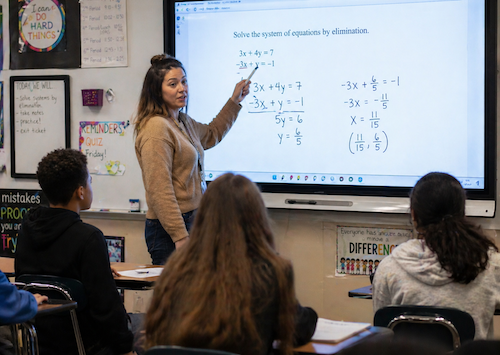
A veteran high school math teacher with two decades of classroom experience discovered something unexpected during a professional learning session on early mathematics. Years of direct instruction and standard practice methods had masked a fundamental gap: the teacher lacked confidence in their own understanding of how students actually learn math.
This revelation points to a widespread problem in American schools. Teacher confidence in mathematics teaching remains low, even among experienced educators. When teachers doubt their grasp of math content or pedagogy, students absorb that uncertainty. Classrooms become places where math feels threatening rather than accessible.
District leaders bear responsibility for closing this confidence gap, and research offers clear pathways forward.
The first step involves shifting how districts approach professional development. One-shot workshops and compliance-based training do not build lasting teacher confidence. Instead, districts must fund sustained learning communities where teachers study math content deeply and observe how students actually process mathematical thinking. These sessions work best when they focus on early math concepts, because understanding foundational ideas transforms how teachers approach later, more complex topics. A teacher who truly grasps why addition works differently from multiplication can explain these distinctions clearly to students.
Second, districts need to create psychological safety in professional spaces. Teachers who have taught math the same way for years may feel defensive when asked to reconsider their methods. District leaders must frame learning as professional growth, not judgment. When teachers see peers wrestling with new ideas, asking questions, and even getting problems wrong during collaborative sessions, the classroom becomes less intimidating. This mirrors what we want in student classrooms: safe spaces to struggle and learn.
Third, district leaders should pair professional learning with classroom support. Coaching, co-teaching, and peer observations help teachers translate new knowledge into practice. A teacher who understands research on conceptual understanding but still defaults to procedural teaching when stressed needs on-the-job support. Instructional coaches can model strategies, debrief lessons, and provide feedback without judgment. This turns professional development from an event into an ongoing process.
Fourth, measurement matters. Districts should assess teacher confidence and knowledge before, during, and after initiatives. This is not about evaluating teachers for employment decisions. Rather, it provides evidence about what works. If a district invests in a math coaching program and teacher confidence remains flat, leaders need data to adjust. Confidence surveys paired with student achievement data reveal whether teacher growth translates into student learning gains.
When district leaders prioritize these four elements, classrooms shift. Teachers who understand math deeply and feel confident in their knowledge teach differently. They ask better questions. They listen to student thinking instead of rushing to correct wrong answers. They model productive struggle. Students pick up on this shift immediately. Math stops feeling like a set of rules to memorize and starts feeling like a puzzle to solve together.
The teacher who attended that professional learning session on early math went back to the classroom changed. That kind of transformation happens district-wide when leaders commit resources, time, and attention to building teacher confidence. It is an investment that pays dividends in student learning.