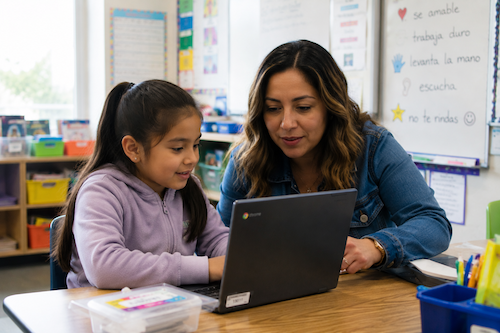
# Oracy Offers Critical Pathway for Multilingual Students to Build Academic Voice
For multilingual learners, mastering spoken language skills represents far more than a single subject area. Oracy—the capacity to communicate effectively through speaking and listening—serves as the foundation for accessing entire curricula and participating fully in classroom life.
The distinction matters. While traditional language instruction focuses on reading and writing, oracy addresses the lived reality of multilingual students who must navigate complex verbal exchanges daily. Teachers pose questions. Peers debate ideas. Lessons unfold through discussion. Without explicit oracy instruction, multilingual learners fall behind not because they lack intelligence but because they lack the specific tools to engage verbally in academic settings.
The research on oracy shows clear benefits. When schools embed oracy into their teaching practices, students transition from passive answering into active reasoning. They move from mere participation—raising a hand, giving one-word responses—to genuine contribution through extended explanations and counterargument. Silence transforms into voice. This shift proves especially powerful for multilingual students who often feel unseen or underestimated in classrooms where verbal performance determines visibility.
Oracy differs fundamentally from general "communication skills" training. True oracy instruction builds specific competencies: organizing thoughts into coherent sequences, using academic vocabulary precisely, listening actively to peers, and adapting language register to match context. For multilingual learners, these skills unlock access to content across mathematics, science, history, and every other subject.
Schools implementing oracy frameworks report measurable gains in student engagement and confidence. When teachers create structured opportunities for talk, multilingual students participate more frequently and at greater depth. They make connections between concepts. They challenge ideas respectfully. They develop the linguistic stamina required to sustain academic conversations. These outcomes extend beyond language arts into all disciplines.
The challenge lies in inconsistent implementation. Many schools treat oracy as peripheral or assume it happens naturally through group work. Research indicates this approach fails. Oracy requires deliberate teaching. Teachers need professional development to understand how to scaffold talk, ask open-ended questions, and create psychological safety for language risk-taking. Curriculum materials must build oracy systematically across grade levels and subjects.
Several education organizations now champion oracy integration specifically for multilingual learners. Programs focused on English learners increasingly recognize that vocabulary lists and grammar worksheets prove insufficient without corresponding oral language development. The most effective approaches combine explicit instruction, peer-to-peer dialogue opportunities, and teacher feedback on speaking quality.
The stakes prove high. Students who develop strong oracy skills show improved outcomes in academic achievement, college readiness, and workforce preparation. Multilingual learners who master academic English through oracy pathways access better educational trajectories. Those without this support often remain tracked in remedial courses despite possessing intact cognitive abilities.
Implementation requires shifting how educators allocate classroom time and resources. Rather than viewing talk time as interruption or indulgence, teachers increasingly recognize structured discussion as essential instructional time. For multilingual students, this reframing proves transformative. Their voices emerge. Their thinking becomes visible. Their participation shapes classroom knowledge-building.
The evidence points clearly: oracy is not supplementary enrichment for multilingual learners. It represents a foundational necessity for educational equity.