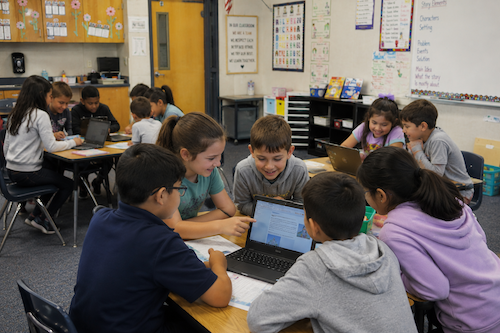
# Building Math Skills Through Real-World Design Projects
Project-based learning is reshaping how elementary and middle school students learn math by anchoring abstract concepts in tangible, real-world problems. Rather than solving disconnected equations on worksheets, students now apply mathematical thinking to concrete challenges like designing functional backpacks, building structures, or creating digital products.
This pedagogical shift matters because math proficiency in middle grades directly predicts success in high school algebra and beyond. When students fail to grasp foundational concepts like measurement, geometry, and proportional reasoning, they carry those gaps forward. Project-based learning targets this weakness by making math concepts visible and necessary rather than arbitrary.
In traditional instruction, students learn formulas first and search for applications second. With PBL, the formula emerges from the problem. When tasked with designing a backpack, students encounter real constraints: weight limits, material costs, compartment dimensions, and strap proportions. These constraints demand mathematical solutions. A student calculating how much fabric covers a curved pocket is doing geometry. One optimizing weight distribution across compartments is applying algebra and physics principles. Another comparing bulk prices across suppliers practices ratio and proportion.
The backpack design project exemplifies this approach. Students measure human dimensions, sketch prototype patterns, calculate surface area and volume, estimate production costs, and test their designs against performance criteria. Mathematics becomes a tool they need rather than a subject they endure. This shift in perspective carries psychological weight. Students who view math as disconnected procedural steps often disengage. Those who solve genuine problems using math report higher confidence and retention.
Research on PBL outcomes shows mixed but generally positive results. Studies from schools implementing project-based approaches report improved conceptual understanding and stronger problem-solving skills, though standardized test score gains vary by implementation quality. The most successful programs feature teachers trained in facilitating inquiry-driven work, access to materials and tools, and clear learning objectives aligned to standards.
Implementation challenges exist. PBL requires significant planning time and classroom flexibility. Teachers must balance open-ended exploration with accountability for specific standards. Not all mathematics concepts fit naturally into projects. Some procedural fluency still demands direct instruction and practice. The most effective programs use PBL strategically, combining it with explicit teaching rather than replacing traditional instruction entirely.
School districts adopting PBL report positive shifts in student engagement and attendance, particularly among students who previously disengaged from traditional math classes. Teachers note that when students see mathematics as purposeful, behavioral issues and anxiety decrease. Parents sometimes worry about rigor, questioning whether project work covers enough content. Districts addressing this concern publish clear alignment documents showing how each project addresses specific standards and develops specific competencies.
The backpack project also develops non-academic skills employers value. Students communicate design decisions, collaborate across roles, manage timelines, and revise work based on feedback. These capabilities complement pure mathematical skill and prepare students for technical careers in engineering, architecture, and design.
As elementary and middle schools continue adopting project-based models, the challenge lies in scaling implementation without diluting quality. Professional development for teachers, access to design tools, and institutional support determine whether PBL becomes meaningful transformation or surface-level activity. Schools investing in these supports report stronger outcomes and more sustained adoption.