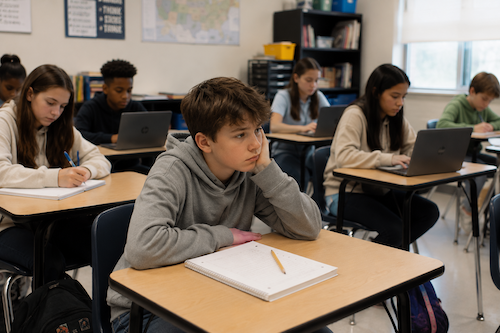
# Student Disengagement Signals Need for Classroom Redesign
Teachers across the country are reporting a troubling pattern. Students are tuning out at higher rates than in recent years, and the problem extends far beyond typical classroom management challenges. Research and educator observations point to a fundamental mismatch between how many classrooms operate and what actually captures student attention and builds lasting learning.
The issue is not primarily about student behavior or motivation deficits. Instead, disengagement often reflects poorly designed learning experiences that fail to activate genuine curiosity or relevance. When students sit passively through lectures, worksheets, and standardized routines disconnected from their lives and interests, mental checkout becomes rational rather than rebellious.
Several structural factors drive this disengagement. Post-pandemic learning loss and recovery efforts have intensified pressure on standardized testing and curriculum pacing, squeezing out time for active exploration or student choice. Screen fatigue after years of hybrid and remote learning has left many students less tolerant of teacher-centered instruction. Social and emotional recovery needs remain unmet in many schools, leaving students anxious or withdrawn. And shifts in adolescent social dynamics, partly accelerated by social media, have rewired how young people engage with authority figures and traditional institutions.
Schools that have moved toward student-centered design report better outcomes. Rather than asking students to fit rigid structures, these classrooms start with student interests, questions, and strengths. Project-based learning, collaborative problem-solving, and real-world application create conditions where engagement follows naturally because students see the point. Teachers function as facilitators and guides rather than sole information sources.
This redesign requires concrete changes. Classrooms need flexible physical spaces that support group work, not just rows of individual desks. Curriculum should include student voice in what gets studied and how. Assessment practices should measure growth and understanding, not just compliance. Teachers need time to collaborate on instructional design and professional learning around engagement strategies.
Some districts have piloted classroom redesigns with measurable results. When students have input on how they demonstrate knowledge, when learning connects to their lives or communities, and when peer collaboration is built into daily practice, attendance improves, behavioral incidents decline, and academic growth accelerates. The Tennessee Department of Education, for example, has supported schools experimenting with competency-based progression that allows students to advance upon mastery rather than on seat time, increasing relevance and ownership.
The barrier is not evidence. Educators know that engaged students learn better. The barrier is systemic inertia. Teacher training programs often emphasize content delivery over facilitation. Testing regimes reward coverage over depth. Scheduling locks learning into 45-minute periods regardless of task. Budgets constrain renovation of physical learning spaces.
Change requires district-level commitment. Leaders must examine policies that unintentionally reinforce passive learning. Professional development must build teacher capacity in facilitation and classroom design. Time must be protected for collaborative planning. Families need communication explaining that this redesign serves the same learning goals but through more effective pathways.
The evidence is clear. Traditional classroom design works for a shrinking percentage of students. Those who thrive in lecture-based, teacher-directed, standardized formats remain capable. Everyone else tunes out. Districts that acknowledge this reality and invest in redesign report transformed results within two to three years.