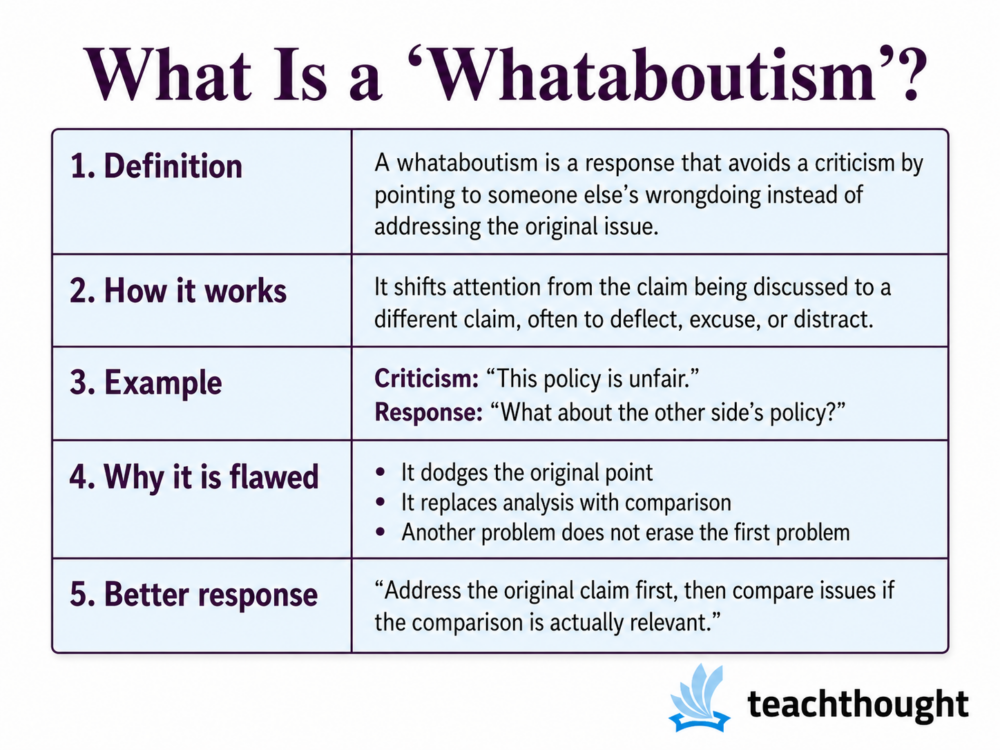
Whataboutism is a rhetorical tactic that sidesteps direct responses to criticism by pivoting to a different, often unrelated problem. The term describes what happens when someone responds to an accusation with "What about...?" instead of addressing the original claim.
This deflection strategy operates across education contexts. A school administrator facing questions about inadequate special education funding might respond by pointing to budget cuts in athletics. A teacher accused of unfair grading practices might counter by highlighting discipline issues in the classroom. A district defending standardized testing requirements might redirect by citing college admission standards.
The tactic creates several problems in educational discourse. First, it prevents substantive dialogue about the actual issue. When concerns about teacher pay are met with "What about declining graduation rates?", neither problem gets solved. Second, it assumes equivalence between unrelated problems. A genuine policy debate requires examining each issue independently, not stacking them against each other as though addressing one automatically justifies ignoring the others.
Educators and parents encounter whataboutism regularly in policy discussions. During debates over curriculum content, whataboutism appears when supporters of contested material respond to concerns by asking "What about the books they want removed?" Both questions deserve separate, thoughtful answers.
Teaching students to recognize whataboutism builds critical thinking skills. When students learn to identify this deflection, they develop stronger argumentation abilities. They understand that acknowledging a second problem does not invalidate the first one. They recognize that valid criticism of one system does not disappear because other systems have flaws.
Distinguishing whataboutism from legitimate comparative analysis matters. Comparing two policies to understand their relative merits differs from using one policy's existence to dismiss concerns about another. The key difference lies in intention. Genuine policy comparison aims to clarify choices. Whataboutism aims to escape accountability.
Schools benefit when administrators, teachers, and students engage