# From Screen To World: 5 Ways To Use AI To Spark Hands-On Learning In K–12 Classrooms
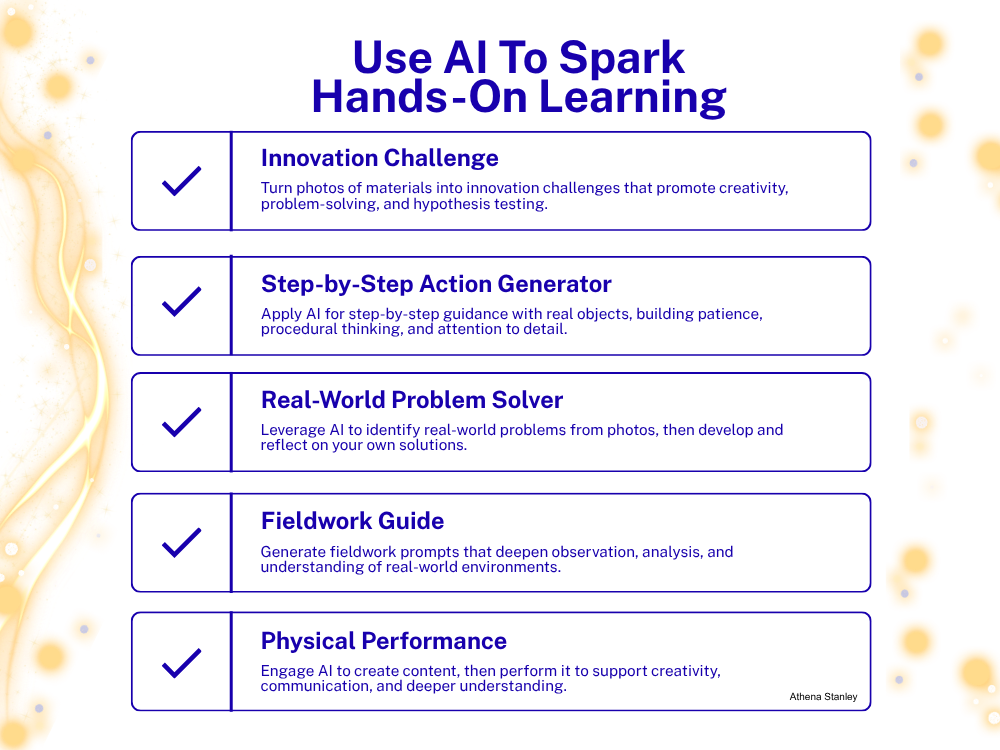
Teachers across K-12 schools are embedding artificial intelligence into physical, hands-on learning activities that connect classroom work to real-world problem-solving. One emerging model asks students to photograph their immediate environment—a classroom corner, playground, neighborhood street, or home space—then use AI tools to identify problems within those settings without receiving automated solutions.
This approach combines visual documentation with AI analysis while preserving the critical thinking required for actual problem-solving. Students must move from observation to AI-generated problem identification to independent solution design. The method pushes back against passive screen time by anchoring digital tool use to tangible environments and student agency.
Other classroom implementations mentioned in TeachThought's framework include using AI to generate discussion prompts tied to student-collected data, create personalized learning scaffolds based on student photography or field observations, and produce follow-up questions that deepen inquiry. Teachers report that this reverses typical tech integration patterns. Rather than AI replacing human thinking or limiting students to predetermined answers, the tool functions as a problem-identification partner that launches deeper investigation.
The framework reflects growing educator interest in what some call "AI-augmented learning"—using generative tools not to automate thinking but to accelerate the transition from abstract classroom concepts to concrete community work. Students photograph deteriorating playground equipment and AI identifies safety issues; students then research repair options, cost estimates, and community contacts. Or they document food waste patterns in their school cafeteria and use AI to organize their observations into actionable categories before designing intervention proposals.
This model assumes reliable classroom access to AI tools and smartphones or cameras, which remains unequal across school districts. Implementation also depends on teacher training and time for lesson design that weaves these steps together deliberately. When executed well, educators note that students show higher