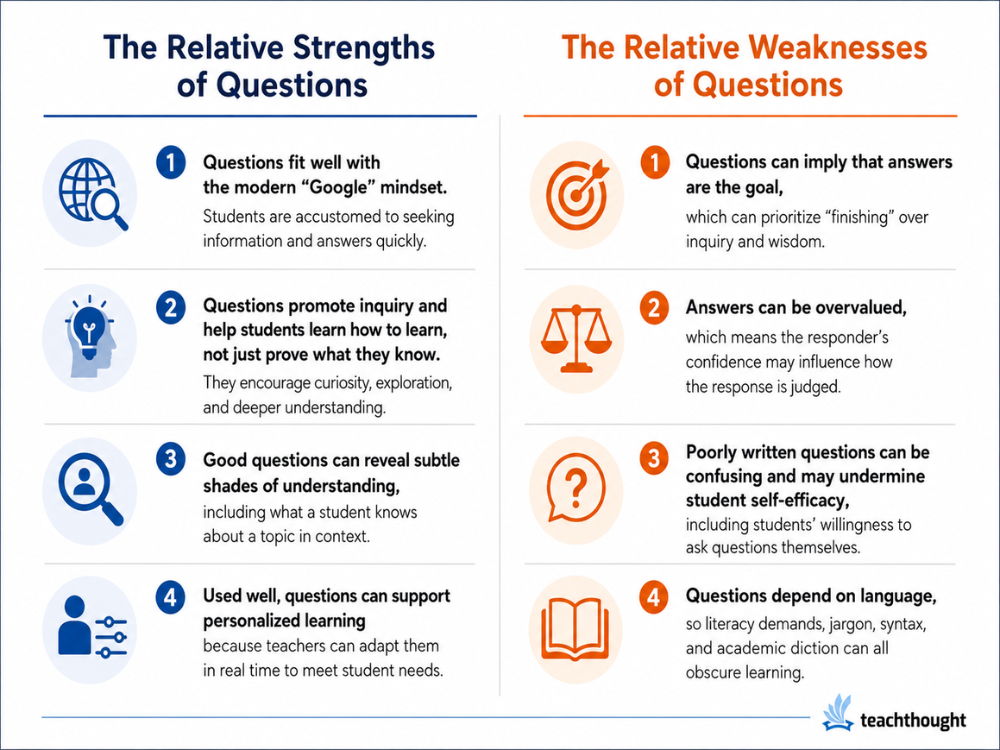
# Questioning Techniques Shape Student Learning and Teacher Assessment
Teachers who master strategic questioning unlock deeper student understanding and reveal genuine comprehension more reliably than traditional tests. Research shows that the quality and timing of classroom questions directly correlates with student engagement and conceptual mastery.
Effective questioning goes beyond recall. Teachers who ask open-ended questions, wait for student responses, and follow up with probing prompts create space for students to construct meaning rather than simply retrieve facts. This approach distinguishes between surface-level learning and authentic understanding.
TeachThought identifies several questioning frameworks worth implementing. Bloom's taxonomy remains foundational, moving students from remembering and understanding through application, analysis, synthesis, and evaluation. Socratic questioning, another evidence-backed method, pushes students to examine assumptions and defend reasoning through sustained dialogue.
Timing matters enormously. Teachers who pose a question, then wait three to five seconds before calling on a student increase response quality and participation equity. This wait time allows all students, not just quick processors, to formulate thoughts. Following initial responses with clarifying questions like "How did you reach that conclusion?" or "What evidence supports that?" deepens thinking.
The physical act of questioning serves dual purposes. It diagnoses student misconceptions in real time, allowing teachers to adjust instruction immediately. It also builds student confidence and metacognitive skills, as learners practice articulating their thinking and confronting gaps in understanding.
Schools implementing professional development around classroom questioning report measurable gains in student achievement. Teachers trained in wait time strategies, question sequencing, and responsive follow-up see higher-order thinking emerge more frequently in their classrooms.
Questioning transforms classrooms from teacher-centered monologues into collaborative learning spaces. Students learn not just content, but how to think, how to ask their own questions, and how to defend ideas with evidence. This shift reflects broader movement toward competency-based learning over