# Project-Based Learning Drives Real-World STEM Engagement for Students
Project-based learning (PBL) is reshaping how schools teach STEM subjects by replacing passive textbook instruction with active problem-solving tied to real-world challenges. Rather than memorizing formulas or completing isolated worksheets, students in PBL environments design solutions, run experiments, and collaborate on tasks that mirror work scientists, engineers, and technologists actually do.
The approach reflects a simple truth: students retain knowledge better when they apply it. In a traditional classroom, a student might learn the physics of water pressure from a diagram. In a project-based setting, that same student designs a water filtration system for a community in need, calculating pressure requirements, testing materials, and presenting findings to actual stakeholders. The difference is substantial. PBL anchors abstract concepts in tangible outcomes.
STEM fields increasingly shape career pathways and economic opportunity. The U.S. Bureau of Labor Statistics projects that STEM occupations will grow 13 percent through 2032, compared to 5 percent for all occupations. Yet many secondary students, particularly girls and students from underrepresented communities, exit STEM pipelines early. Disengagement often begins in middle school when instruction becomes more abstract and disconnected from application.
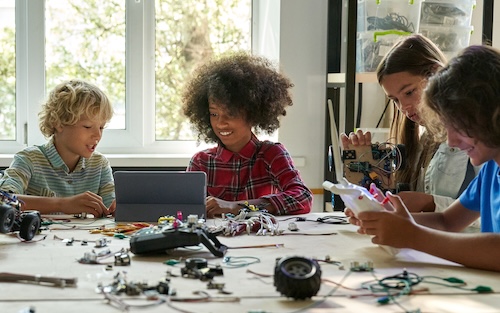
Schools adopting PBL report higher engagement across demographics. When students investigate questions they genuinely want to answer, motivation shifts from external grades to internal curiosity. A robotics design challenge, environmental monitoring project, or coding initiative to solve a local problem creates ownership. Students see themselves as problem-solvers rather than passive recipients of information.
Effective PBL requires structural changes. Teachers need release time for planning, access to materials and technology, and often professional development to facilitate rather than lecture. Schools must also balance PBL with skill-building. Students need foundational mathematics and science knowledge before tackling complex projects. The best implementations weave skill instruction into project cycles rather than treating them separately.
Assessment in PBL differs from traditional testing. Rather than multiple-choice exams, educators evaluate student work through portfolios, presentations, peer feedback, and reflection. This approach captures skills like collaboration and communication that standardized tests miss. It also reveals struggle and growth more honestly than a single test score.
District-level support matters. Schools in systems that allocate budget for PBL resources, provide teacher collaboration time, and align curriculum frameworks around projects see more consistent results than those where implementation remains ad hoc. Some districts partner with external organizations like Project Lead the Way or local industries to strengthen authenticity.
Barriers persist. Teachers trained in traditional instruction sometimes struggle with facilitation. Budget constraints limit access to technology and materials in under-resourced schools. And some parents worry that PBL neglects foundational skills. Evidence suggests these concerns are manageable with thoughtful implementation, yet systemic adoption remains uneven.
Students in PBL environments often report higher confidence in their ability to tackle unfamiliar problems, a skill with applications far beyond STEM. They develop resilience through iteration, learn to ask better questions, and frequently discover new interests. For schools aiming to broaden STEM participation and deepen learning, project-based approaches offer a proven pathway.