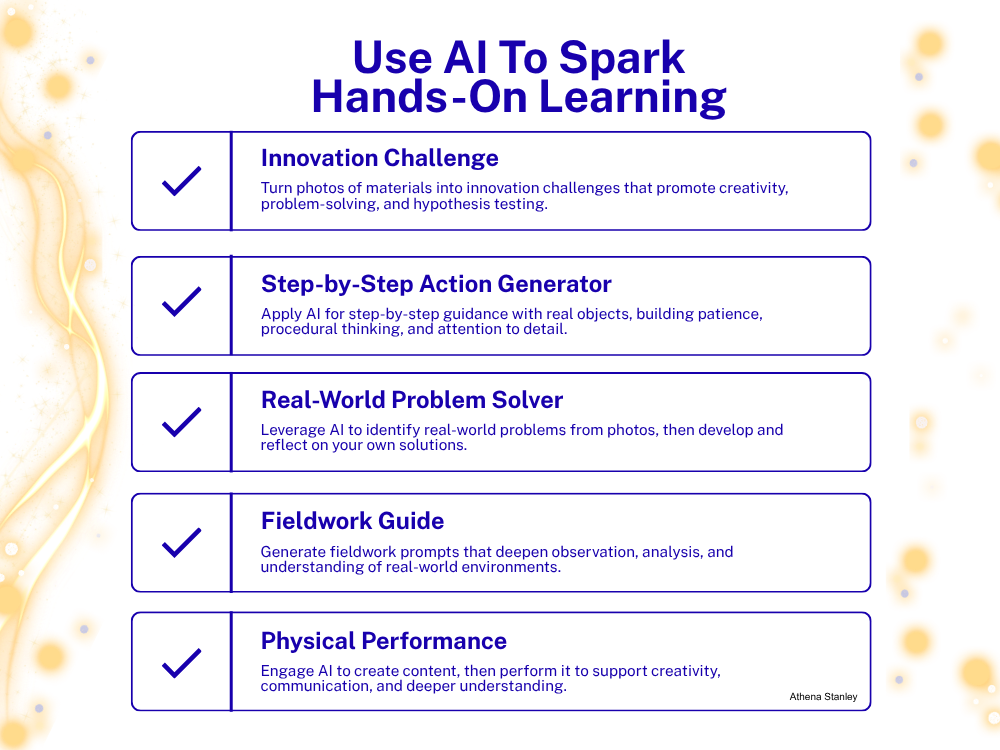
# From Screen To World: 5 Ways To Use AI To Spark Hands-On Learning In K–12 Classrooms
Educators are moving beyond AI chatbots and worksheets to integrate artificial intelligence into physical, project-based learning. TeachThought outlines practical classroom strategies that anchor AI tools to real-world observation and problem-solving.
One method asks students to photograph their immediate environment, whether at school, home, or in their community, then use AI to identify problems within that setting without providing solutions. This approach bridges digital tools and tangible learning. Students develop observation skills while using AI as an analytical partner rather than an answer generator.
The method reflects a broader shift in K-12 AI integration. Rather than treating AI as a replacement for hands-on work, teachers position it as a catalyst for deeper exploration. Students gather data, photograph conditions, and analyze findings using AI assistance. They then move from screen-based diagnosis to real-world action.
This framework addresses common educator concerns about over-reliance on technology. By requiring students to first observe their physical surroundings and then apply AI analysis, classrooms maintain the rigor of traditional project-based learning while incorporating modern tools. Students practice critical thinking by questioning AI outputs and designing solutions grounded in community needs.
The approach works across subjects. Science students might photograph water quality issues. Social studies classes could document neighborhood infrastructure gaps. Environmental science projects become investigations where AI helps categorize observations but students drive the research direction and solution development.
Schools adopting this model report increased student engagement and ownership of learning. Rather than passively receiving information, students become investigators who use technology to deepen understanding of problems they've personally witnessed.
The strategy also builds media literacy. Students learn to evaluate AI-generated analysis, test its accuracy against observable reality, and recognize when AI outputs need human judgment. This mirrors skills professionals use across fields where AI tools support but