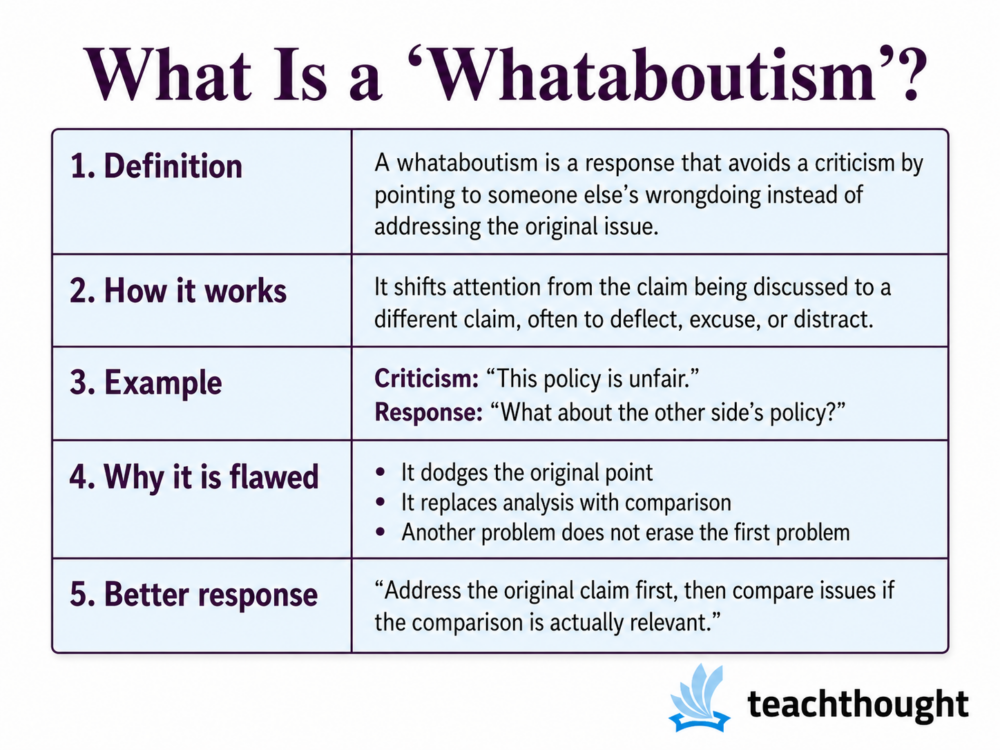
Whataboutism is a rhetorical technique that deflects from a direct question or criticism by redirecting focus to a different, often unrelated problem. Rather than addressing the original claim, a person using whataboutism responds with "what about..." followed by another issue, creating confusion and avoiding accountability.
This tactic appears regularly in public discourse, politics, and social media. It works by introducing a counterargument that seems to challenge the questioner's credibility or consistency rather than defending the original position. For example, if someone criticizes a school's discipline policy, a whataboutism response might redirect to complaints about school funding instead of engaging with the discipline question directly.
TeachThought identifies whataboutism as a critical literacy concept that educators should teach students to recognize. Understanding this deflection technique helps young people evaluate arguments more carefully and identify when conversations have been derailed without resolution.
Teachers can use classroom discussions and media analysis exercises to show students how whataboutism operates in real debates. Students benefit from learning to spot the difference between legitimate counterarguments, which directly address the original claim, and whataboutism, which simply changes the subject.
Recognizing whataboutism builds stronger critical thinking skills. Students who understand this pattern become more effective communicators, better equipped to hold conversations accountable to their stated purpose. They learn to politely redirect conversations back to the original topic and demand substantive responses rather than deflections.
This skill connects to broader information literacy standards, where students evaluate sources, identify bias, and distinguish between logical arguments and rhetorical manipulation. Schools teaching argument analysis, debate, and media literacy naturally incorporate whataboutism recognition into their curriculum.