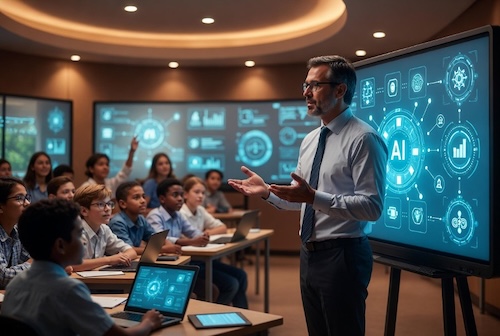
# Teachers and AI: A Shift in Educational Leadership
Public schools face a fundamental shift in how teaching operates as artificial intelligence and technology reshape the classroom. Rather than replacing educators, these tools amplify teacher expertise and enable personalized learning at scale.
The article frames this moment as an opportunity for teachers to lead differently. Traditional instruction, where teachers deliver uniform lessons to diverse learners, gives way to a model where technology handles routine tasks like grading, attendance tracking, and initial content delivery. Teachers then focus on what humans do best: mentoring, problem-solving, and adapting instruction to individual student needs.
AI-powered platforms can analyze student performance data in real time, flagging which learners need intervention and which are ready to advance. This allows teachers to target instruction precisely rather than pacing classes for an imaginary average student. Personalized learning systems free teachers from one-size-fits-all constraints.
The technology also addresses workforce pressures. Teacher shortages persist in many districts. AI tutoring systems and automated assessment reduce grading burden by as much as 10-15 hours per week according to early pilots. That time returns to lesson planning, student conferences, and professional development.
But success requires training and support. Teachers need professional development not just in tool mechanics but in pedagogical shifts. How do you teach critical thinking when students have instant AI access to information? How do you assess learning when AI can generate essays? These questions demand thoughtful answers from educators themselves.
The framing here matters. This is not about AI replacing teachers but teachers using AI to work differently. Educational leaders emphasizing this distinction report higher adoption rates and teacher buy-in. Schools that position technology as amplifying expertise rather than threatening jobs see teachers leading implementation rather than resisting it.
The timing coincides with growing recognition that education systems must personalize at scale to meet diverse learner needs. Technology creates that possibility. Teachers who embrace these tools