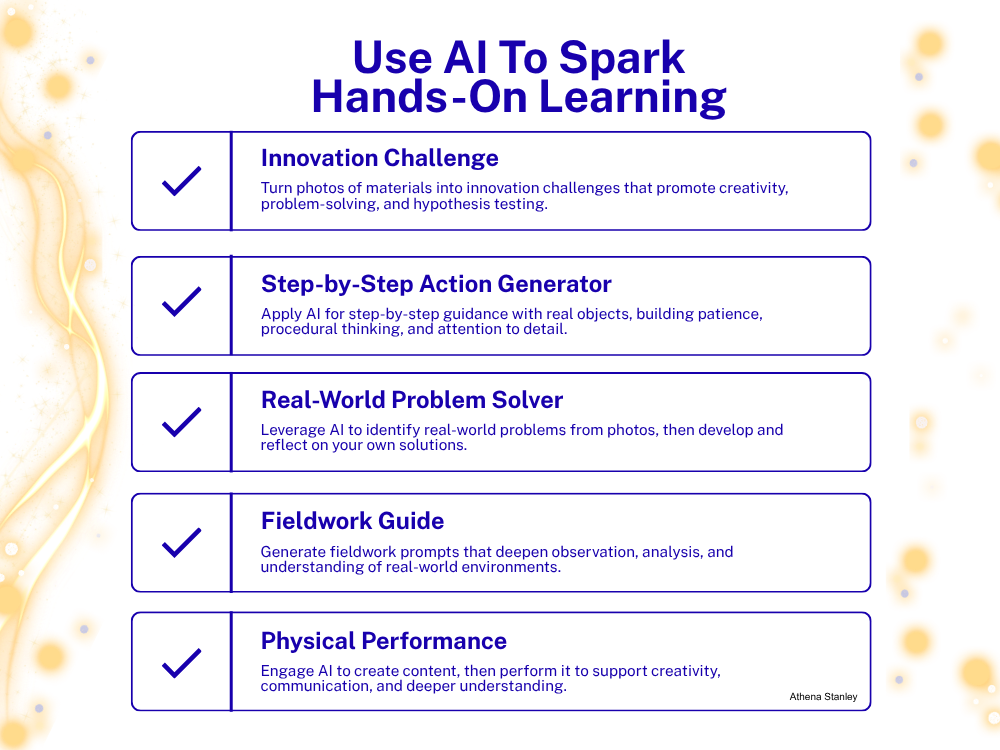
# From Screen to World: 5 Ways to Use AI to Spark Hands-On Learning in K–12 Classrooms
Teachers are finding practical ways to blend artificial intelligence with physical, real-world learning in K-12 classrooms. Rather than keeping AI confined to screens, educators use it as a bridge between digital tools and tangible problem-solving.
One approach asks students to photograph their environment, then use AI to identify problems without generating solutions. A student might photograph a cluttered hallway, a leaky playground fixture, or a community intersection and prompt an AI tool to spot inefficiencies or hazards. The AI describes what it observes. Students then research and develop their own fixes.
This method flips traditional lesson design. Instead of teachers assigning problems from textbooks, students discover authentic challenges in spaces they navigate daily. They own the problem-finding phase rather than receiving pre-packaged scenarios.
The practice encourages observation skills that AI-assisted analysis can sharpen. Students learn to ask precise questions of the technology, then translate AI feedback into local action. A middle schooler might use an AI tool to analyze a neighborhood's accessibility barriers, then propose solutions to the city council. High school students could photograph their school's energy use, get AI analysis of inefficiencies, and design conservation initiatives.
This blend of digital literacy and hands-on work addresses a persistent classroom gap. Students often see AI as a tool for writing essays or summarizing information. Connecting AI to community problem-solving broadens their understanding of what the technology can do and why it matters beyond academic work.
Teachers using this method report increased engagement when students work on real places they care about. Younger students practice observation and basic analysis. Older students develop research and advocacy skills.
The approach assumes schools have reliable device access and that students can safely photograph public spaces. Implementation varies by age group and community norms. But