# How Breaking Words Changed the Way My Students Approach Language
A teacher discovered that many students in her classroom could decode words through phonics but struggled to understand what those words actually meant. When asked to explain vocabulary, students would disengage or give up entirely.
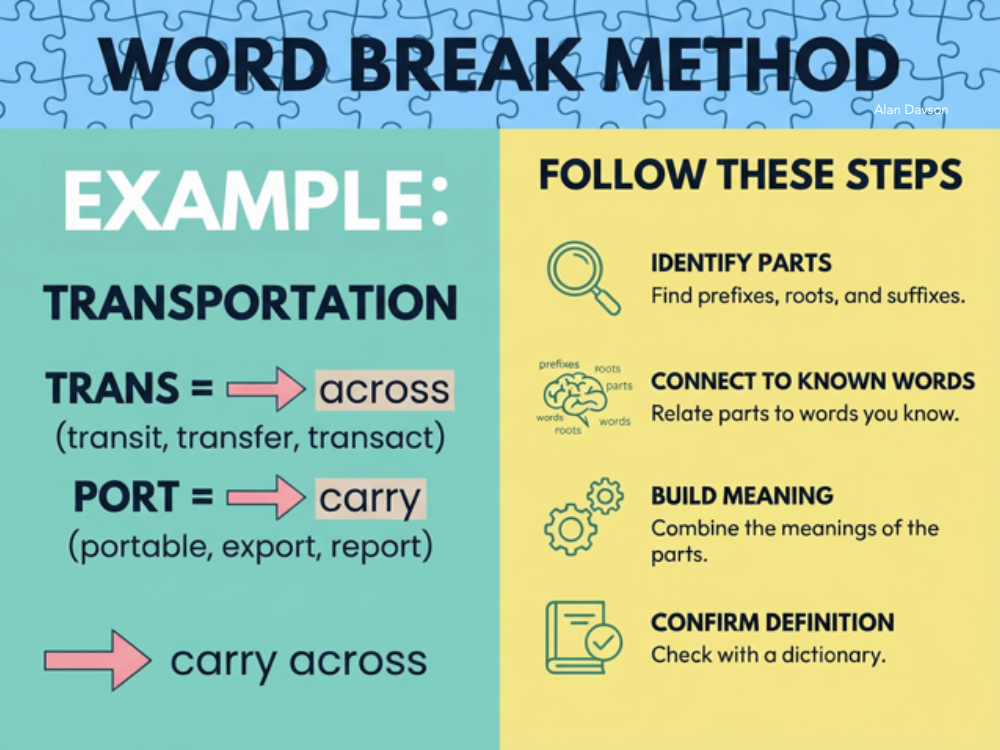
The solution involved explicit instruction in morphology, the study of word structure and composition. By teaching students to break words into smaller components like roots, prefixes, and suffixes, the teacher helped them build comprehension alongside decoding skills. This approach connects pronunciation to meaning in a direct way.
For example, students who learn that the prefix "un-" means "not" or that the suffix "-tion" signals a noun can decode unfamiliar words and grasp their definitions simultaneously. Rather than treating word recognition and word meaning as separate tasks, morphological instruction links them.
The strategy addresses a widespread gap in literacy instruction. Many reading programs prioritize phonetic decoding without equally emphasizing how words are constructed. Students become fluent readers who can pronounce text but lack the semantic depth needed for comprehension and academic writing.
Research supports this approach. Studies show that morphological awareness improves vocabulary growth and reading comprehension across grade levels, particularly for struggling readers and students learning English as an additional language. The connection between word parts and meaning becomes especially powerful when taught systematically rather than incidentally.
Teachers using this method report that students gain confidence. Breaking words into parts removes the sense that vocabulary is arbitrary or random. Students see patterns. They begin applying morphological reasoning to words they encounter independently, extending learning beyond classroom lessons.
This shift requires teachers to view their role differently. Rather than simply teaching word lists, educators become architects of language structure. The classroom becomes a place where students develop tools for lifelong vocabulary growth and deeper text comprehension.