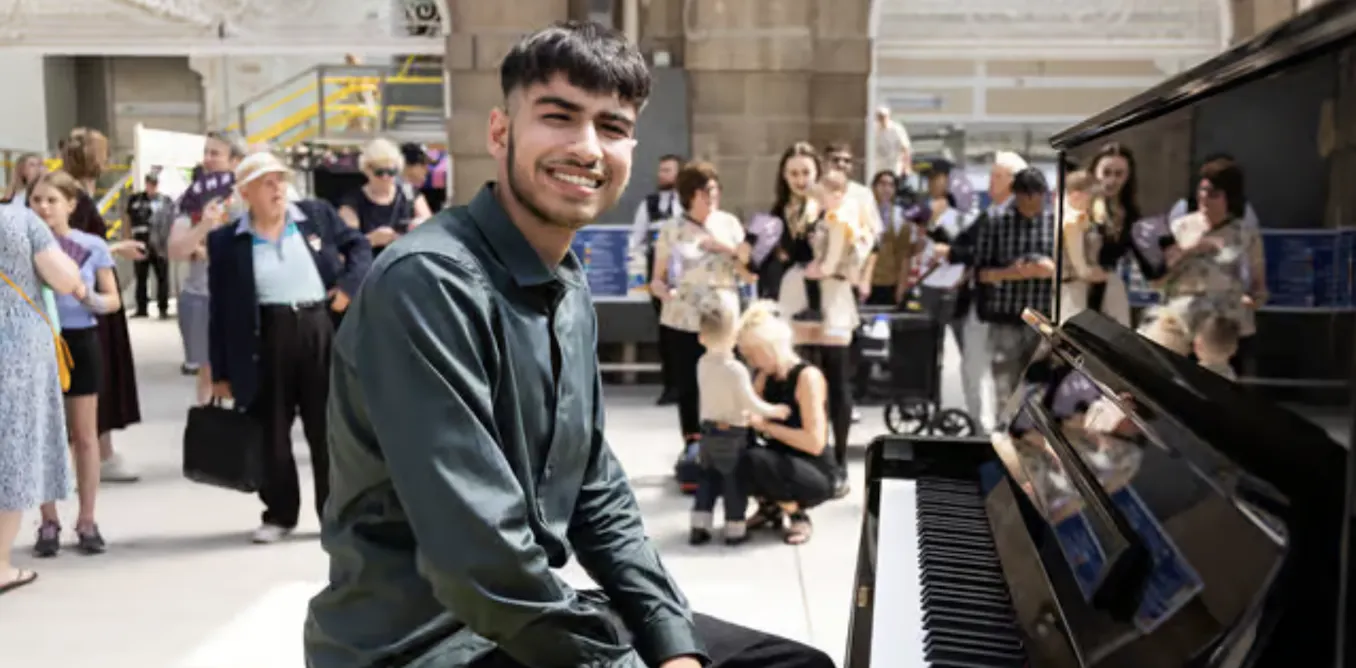
# The Piano: Public Performance as Modern Music Salon
Street pianos have become a social media phenomenon. Videos of musicians playing in public spaces accumulate millions of views. People stop to listen. They record and share. The trend mirrors something education historians recognize from an earlier era.
In the 19th century, musical talent spread through different channels. Invitations to private music salons built reputations. Conversation between attendees carried news. Print publications reviewed performances. Gossip amplified interest. Musicians gained prominence not through mass media, but through curated social networks.
Today's street piano videos work similarly. A commuter spots a musician at a train station. They film the performance. The video travels through social networks. Comments build momentum. The musician gains visibility without traditional gatekeepers like concert halls or record labels.
Both systems rely on genuine talent and audience reaction. A 19th-century salon guest either enjoyed the music or did not. Social media viewers either pause to watch or scroll past. Neither circumstance guarantees success or income. What changes is the speed and scale of distribution.
The parallel matters for music education and cultural access. Street pianos democratize performance space. They eliminate venue costs and formal audition processes. Young musicians develop audiences without institutional backing. This resembles the 19th-century salon system, which also permitted musicians outside formal institutions to build followings.
The difference lies in documentation and reach. A salon performance reached dozens. A viral piano video reaches thousands or millions. The audience composition changes too. Salon attendees typically shared class status and musical training. Street piano viewers span age, geography, education level, and musical knowledge.
This shift has practical implications. Musicians can build platforms faster. Educators see potential in public performance spaces as teaching tools. Communities invest in street pianos as cultural infrastructure.
The comparison reveals something deeper. Music's power to move audiences transcends era. Whether