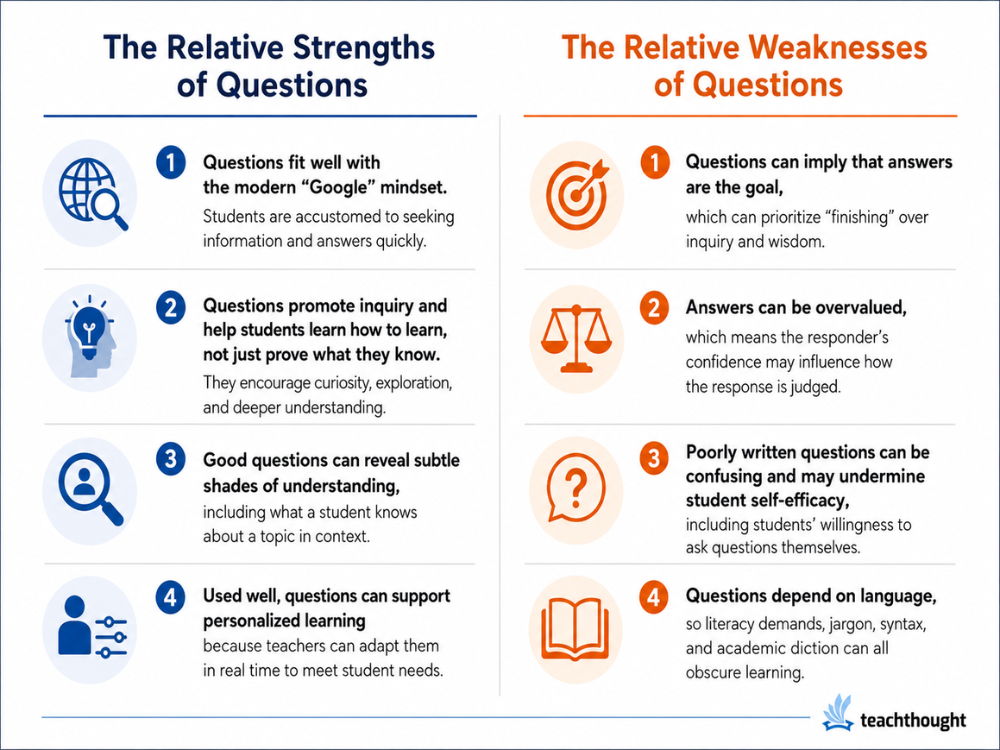
# An Updated Guide to Questioning in the Classroom
Teachers who master the art of questioning unlock deeper student learning. The ability to ask the right question at the right time reveals authentic understanding, serving as both a teaching tool and an assessment method.
Effective classroom questioning goes beyond simple recall. Research in cognitive science shows that questions structured to prompt critical thinking drive student engagement and retention. Teachers who emphasize open-ended questions rather than yes-or-no responses create space for students to articulate reasoning, test hypotheses, and build confidence in their own thinking.
The timing and type of question matter enormously. Bloom's revised taxonomy provides a framework many educators use to design questions that progress from lower-order thinking (remembering, understanding) to higher-order thinking (applying, analyzing, evaluating, creating). A teacher might begin by asking students to recall facts, then shift to questions requiring comparison, inference, or justification of ideas.
Wait time also shapes outcomes. Research by Mary Budd Rowe found that when teachers wait at least three seconds after posing a question, more students attempt answers, responses become longer and more complex, and student confidence increases. Brief pauses signal to students that thoughtful responses matter more than quick replies.
Questioning serves dual purposes in today's classrooms. It functions as formative assessment, revealing gaps in understanding without formal testing. Teachers gain real-time insight into student thinking and adjust instruction accordingly. Simultaneously, questioning models intellectual habits students need to develop. When teachers ask genuinely curious questions, students learn that learning involves wondering, testing ideas, and revising thinking.
Classroom questioning also builds equity. Students from different backgrounds and learning profiles respond differently to question types. Some thrive with concrete examples first; others benefit from abstract conceptual questions. Varying question formats and allowing multiple ways to respond ensures more students participate and demonstrate knowledge.
Effective questioning transforms classrooms from spaces where teachers