# What Is Whataboutism?
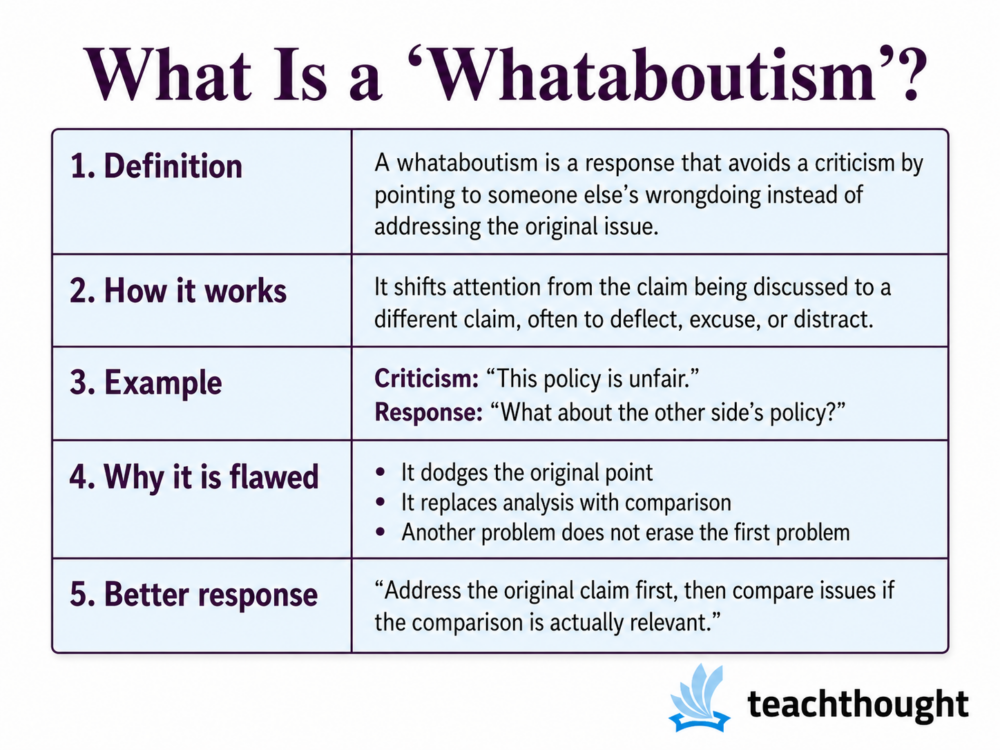
Whataboutism is a rhetorical deflection that avoids answering a claim by shifting attention to a different issue. Instead of engaging with the original argument, someone using whataboutism responds with a counterargument that redirects the conversation entirely.
The term gained prominence during Cold War-era geopolitical debates, but it now appears regularly in classrooms, political discourse, and online spaces. When confronted with a criticism, a person employing whataboutism responds by saying, "What about..." and pivots to a separate problem or instance they believe is equally or more problematic.
For example, if someone criticizes a school's handling of bullying, a whataboutism response might be, "What about all the other schools that have worse problems?" This move avoids addressing the original bullying claim and instead introduces an unrelated comparison.
The tactic differs from legitimate counterargument or whatabout questions that genuinely explore context. True engagement requires addressing the initial claim before introducing alternative scenarios. Whataboutism skips this step entirely.
Educators increasingly teach students to recognize whataboutism as a critical thinking skill. Identifying deflection helps young people evaluate arguments more rigorously and resist manipulation in conversation. Students who can spot whataboutism develop stronger debate skills and media literacy.
The technique appears across partisan divides. Both sides of educational policy debates use it. During discussions of curriculum standards, testing, or school funding, opponents frequently redirect rather than engage substantively with the evidence presented.
Teachers incorporate whataboutism recognition into lessons on logic, rhetoric, and argumentation. Students learn that strong arguments address claims directly rather than dodge them. This skill extends beyond politics into personal communication, academic writing, and professional settings.
Understanding whataboutism matters because it shapes how people process information and make decisions. When voters,