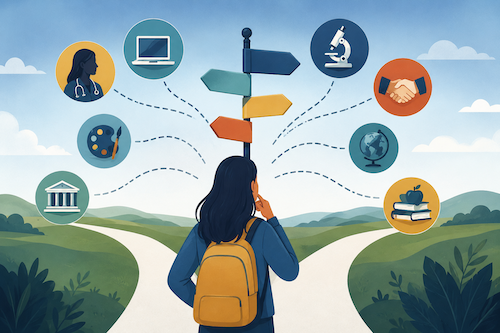
High school students leave their final class unprepared for the decisions that follow graduation. A post-graduation readiness report from YouScience shows most graduating seniors lack skills to navigate their next steps, whether college, career, or trade programs.
The gap centers on decision education. Students receive instruction in academic subjects and career and technical education (CTE) programs, but schools rarely teach them how to actually make informed choices about their futures. This absence creates a hidden curriculum gap that leaves students vulnerable to poor decisions that carry years of consequences.
YouScience's research identifies the problem clearly. Students excel at absorbing content but struggle when asked to evaluate options, understand their own strengths, and connect those strengths to pathways. They cannot articulate why they chose a major or career track. They did not explore alternatives systematically. They did not understand the financial or time implications of their choices.
The issue spans socioeconomic lines but hits lower-income students hardest. Wealthier families often provide informal decision coaching at home. Parents in professional fields guide children through exploratory conversations. Families with college history model the application and selection process. Students without these advantages navigate the transition alone.
Schools integrate career awareness programs and guidance counselors, yet these efforts rarely teach decision-making frameworks. Students learn that plumbing and software engineering exist as options. They do not learn how to evaluate which option fits their values, abilities, and circumstances.
Aligning CTE programs with explicit decision education creates a path forward. When students explore their interests and strengths through hands-on technical work, they gather real data about themselves. Structured decision lessons teach them to weigh trade-offs, research outcomes, and commit to reversible choices while staying alert to irreversible ones.
The hidden curriculum gap reflects a system built to deliver content rather than build judgment. Fixing it requires deliberate instruction in how students think, choose, and prepare