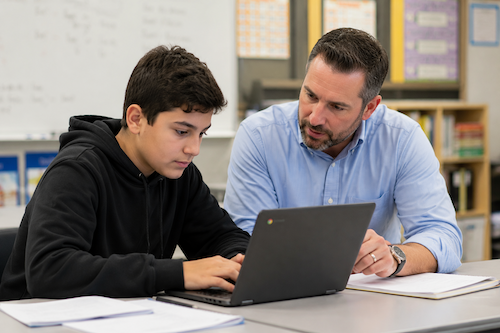
A teacher reflects on the limits of artificial intelligence in student feedback, arguing that algorithms cannot replace the human connection essential to learning.
The educator, reviewing end-of-year student conferences, highlights a conversation with a student named Steven who had struggled with engagement on his final project. This encounter underscores a growing tension in education: schools increasingly turn to AI tools for grading, feedback, and assessment, yet these systems lack the relational depth that drives student growth.
AI feedback systems offer efficiency. They score assignments instantly, flag common errors, and process hundreds of responses without fatigue. But they operate within fixed parameters. An algorithm detects a grammar mistake or structural problem. It cannot detect why a student avoided the work. It cannot ask the follow-up questions that reveal confusion versus carelessness versus disengagement. It cannot adjust tone based on a student's emotional state or learning history.
Teachers know their students. They notice when a quiet student finally speaks up. They recognize when assignment avoidance signals anxiety rather than apathy. They build trust through repeated interaction, understanding each student's strengths, vulnerabilities, and potential. This relationship forms the scaffold on which feedback becomes actionable rather than mechanical.
The article captures a real pedagogical concern. Research on effective feedback emphasizes that students learn more from dialogue than from scores. When a teacher says, "Walk me through your thinking here," students engage in the metacognitive work that builds understanding. When feedback arrives as a comment from an AI system, students often ignore it or view it as generic.
Schools adopting AI assessment tools often frame them as solutions to teacher workload. That framing misses the point. The work of feedback is not simply delivering judgments. It is building relationships that motivate students to revise, to try harder, to believe they can improve. No algorithm generates that belief.
This does not mean rejecting all educational technology. AI can handle routine tasks